

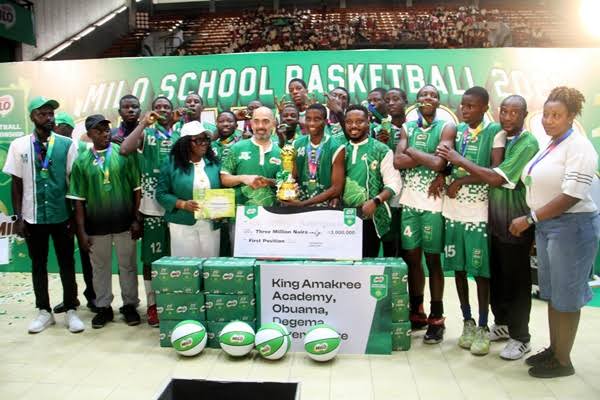
King Amakree Academy, Rivers State, and Government Secondary School (GSS), Gboko, Benue State, won their first-ever national titles at the 26th MILO Basketball Championship National Finals, held at the Indoor Sports Hall of the National Stadium, Surulere, Lagos. Both schools defeated more established programs to claim the trophies, marking a shift from the championship’s usual pattern of repeat winners.
The girls’ final delivered a decisive result: GSS Gboko defeated St. Jude’s Girls Secondary School, Amarata, a program with multiple previous titles, by a commanding 68–36 scoreline. Jersey No. 6, Ada Friday, was named Most Valuable Player of the girls’ tournament, capping what organizers described as an outstanding campaign for a school making its first appearance in the championship spotlight.
The boys’ final was closer. King Amakree Academy edged out Father O’Connell Science College, a three-time national champion and the tournament’s returning titleholder, by a narrow 56–54 margin. Godswill Mene, wearing jersey No. 8, took MVP honors for the boys’ side.
Both results arrived at the end of a tournament that reaches far beyond a single weekend in Lagos. More than 13,000 secondary schools across Nigeria took part this year, competing through the Savannah, Central, Atlantic and Western Conferences before four conference champions and two top-performing runners-up advanced to the National Finals, a scale that makes MILO Basketball one of the largest grassroots sporting programs in the country.
Nestlé Nigeria, which runs the championship under its MILO brand, frames the tournament as something bigger than a basketball competition. Wassim ElHusseini, Managing Director and CEO of Nestlé Nigeria Plc, described the initiative as central to the company’s approach to community investment. “For 26 years, this championship has been about more than basketball,” he said, pointing to discipline, teamwork, resilience and self-belief as qualities the tournament aims to instill alongside athletic skill. Gilbert Tweneboah-Koduah, MILO’s Category Lead, echoed that framing, saying this year’s first-time champions reinforce the idea that “every participating team has the opportunity to succeed, regardless of where they come from or their history in the competition.”
This year’s finals also included an inclusive wheelchair basketball exhibition match featuring young para-athletes, part of what organizers describe as a broader commitment to accessibility within the program. The championship sits alongside MILO’s Building Champs initiative, a school-based physical activity program that reached an estimated 7 million children in 2025, positioning both efforts as part of a longer-term push to get young Nigerians active and engaged in organized sport.