

Uche Cecil Izuora
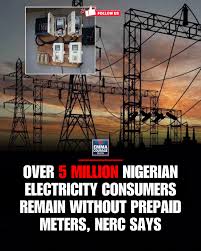
An analyst Judge Etomi, founder of George Etomi and Partners, has raised concerns about the figure that more than five million electricity consumers in Nigeria remain exposed to estimated billing, underscoring the scale of the country’s persistent metering shortfall and the wider structural problems facing the power sector.
Etomi, also said the widely referenced figure of 12.3 million active electricity consumers does not fully capture the reality of electricity usage across households, arguing that the metering deficit is broader than headline customer data suggests.
He said this during a television interview with CNBC, that while several government-backed and market-driven metering programs have been introduced over the years, Nigeria still faces a significant challenge in rapidly closing the gap between connected customers and properly metered users.
According to data cited from the Nigerian Electricity Regulatory Commission, over 72 per cent of electricity distribution companies, or DisCos, failed to meet approved metering thresholds, leaving millions of consumers vulnerable to estimated billing — a longstanding source of frustration for households and businesses.
“Quite a lot still needs to be done in this area,” he said, noting that the sector has struggled for years with the cost of meter deployment, policy inconsistency and weak market liquidity.
At the core of the problem is who pays for metering. Under the current structure, electricity distribution companies are ordinarily responsible for providing meters. But installing meters across millions of households requires substantial capital expenditure, and those investments ultimately need to be reflected in electricity tariffs.
That creates a policy dilemma for regulators. Allowing full cost recovery through tariffs could make electricity less affordable for consumers already grappling with inflation and weak service delivery. But limiting tariff adjustments also constrains DisCos’ ability to finance metering at scale.
“The fear that tariffs could go out of reach of consumers is the main reason why the regulator generally is reluctant” to allow those costs to fully flow through, Etomi said.
To bridge the gap, the federal government has repeatedly intervened. Etomi pointed to a succession of initiatives, including the Credited Advance Payment for Metering Implementation, later replaced by the Meter Asset Provider framework, as well as the Presidential Metering Initiative and other support mechanisms linked to development finance.
These programs were designed to accelerate deployment, improve billing transparency and restore trust between consumers and distribution companies. But Etomi suggested the cumulative results have been mixed.
Metering, he said, is essential not only for accurate billing but also for reducing energy theft, curbing meter bypass and improving accounting for electricity delivered into the grid. Without reliable metering, the sector remains vulnerable to commercial and technical losses, often captured in the industry’s aggregate technical, commercial and collection loss metrics.
“If you do not have reliable metering, you always have a problem with correctly accounting for the energy that’s produced,” Etomi said.
He added that estimated billing continues to be “very, very annoying” for many consumers, especially where supply remains inconsistent.
One of the sector’s additional challenges is that the metering deficit is not static. As more customers are connected to the grid, new demand is created even while existing backlogs remain unresolved. On top of that, older meters eventually need to be replaced, meaning the sector is not only racing to cover unmetered customers but also to maintain the integrity of already installed devices.
“It’s a moving target,” Etomi said, adding that meter replacement cycles, new customer additions and legacy deficits all combine to make the problem harder to solve.
He also highlighted the role of policy continuity. According to Etomi, the earlier CAPMI model, which allowed customers to pay for meters and recover the cost over time through deductions, had shown promise before regulators pivoted toward the Meter Asset Provider model. That shift brought in third-party providers to work alongside DisCos, based on the view that utilities were not moving fast enough on their own.
Still, Etomi said there is ongoing debate over whether the MAP framework has delivered the expected results. With newer interventions such as the Presidential Metering Initiative and World Bank-linked support also entering the space, he described the metering ecosystem as crowded but still not fully effective.
Beyond metering, the interview also addressed the broader debate over electricity tariff bands and service quality. Lagos State has recently raised questions around the current banding framework, under which Band A customers are expected to receive a higher number of supply hours and pay tariffs that more closely reflect the cost of service.
Etomi cautioned against removing the banding system without first addressing the underlying shortage of available power. He said the framework was introduced in part to reduce the federal government’s subsidy burden and to ensure at least one segment of the market pays something closer to the true cost of electricity.
In his view, the bigger problem is not the structure of the bands themselves but the sector’s inability to deliver enough energy consistently, even to premium-paying customers.
“We still have to deal with the fundamentals. We don’t have enough power in the system,” he said.
Removing the current structure prematurely, he warned, could worsen the imbalance between service delivery and revenue collection. That could either force more consumers to pay higher prices for inadequate power or reduce the quality of service for those already paying more.
For now, Etomi said policymakers should focus on improving energy availability, preserving coordination between state actors and the federal regulator, and expanding metering coverage. He stressed that any state-level reform effort, including proposals from Lagos, must be aligned with the Nigerian Electricity Regulatory Commission to avoid further disruption in an already fragile market.
His broader conclusion was that solving Nigeria’s metering challenge requires more than new programs. It will depend on financing, stable policy, stronger utility efficiency and enough electricity supply to make the billing system credible.
Until then, millions of consumers are likely to remain stuck between erratic supply and disputed bills, with the country’s metering target still out of reach.