

Uche Cecil Izuora
Swedish developer Eco Wave Power is exploring another investment opportunity in Africa, where electricity generation from ocean waves remains largely undeveloped.
On Tuesday, November 24, the company announced that its U.S. subsidiary had received a letter of intent from an African power utility to explore the development of up to 100 MW of wave energy capacity. Neither the prospective partner nor the country involved has been identified, and financing arrangements and a development timeline have yet to be established.
This is Eco Wave Power’s second major initiative on the continent.
In July 2025, the company signed an agreement with Africa Great Future Development Ltd. to assess the feasibility of a wave energy project in South Africa,according to Ecofin Agency.
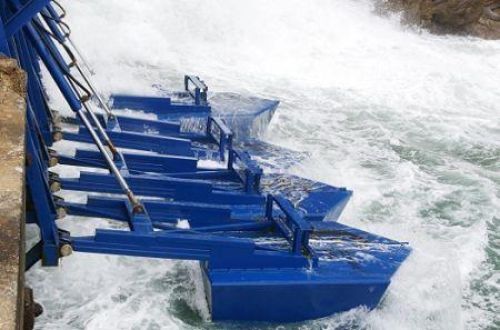
Completed in February 2026, the study identified the technical potential for 8.3 MW of generation capacity at the Port of Ngqura. The proposed technology uses floats attached to existing breakwaters to capture the motion of ocean waves and generate electricity onshore.
Development on the scale under consideration would mark a significant step forward for Africa’s marine energy industry. According to 2026 statistics from the International Renewable Energy Agency (IRENA), the continent had just 2 MW of installed marine energy capacity at the end of 2025, all of it in São Tomé and Príncipe. That represents approximately 0.4 per cent of the 490 MW installed worldwide.
Several stretches of Africa’s coastline nevertheless offer promising wave energy resources.
A study published by the African Development Bank (AfDB) in 2021 estimated average wave power at 40 kilowatts per meter of wave crest in Cape Town, South Africa, 35 kW/m at Faux Cap in Madagascar, and 34 kW/m at Walvis Bay in Namibia. While these figures indicate favorable natural conditions, the feasibility of electricity generation at each location depends on site-specific technical, economic, and environmental factors.
The challenge for developers is to translate Africa’s natural wave energy resources into commercially operational power plants. Ghana offers an example of the difficulties involved. Swedish developer Seabased completed a pilot demonstration project at Ada Foah in 2016. In March 2018, it signed a contract with Ghanaian company TC’s Energy to develop a 100 MW wave energy power plant.
An attempt to revive the project followed in July 2020, when TC’s Energy USA, Seabased, and Power China Huadong Engineering Corporation signed an agreement under which the Chinese company was expected to help finance the development. Despite the renewed effort, the project never reached commercial operation.
In March 2024, the Ghana News Agency reported that local traditional authorities were still concerned about the suspension of work on the project.
Ghana’s official power purchase agreement portal also indicated in its October 2026 update that the development had yet to reach financial close.
Ghana’s experience highlights the gap between Africa’s wave energy potential and the industry’s commercial development. Despite abundant natural resources along parts of the continent’s coastline and interest from several developers, bringing wave-powered electricity generation into commercial operation remains a significant challenge.