

Uche Cecil Izuora
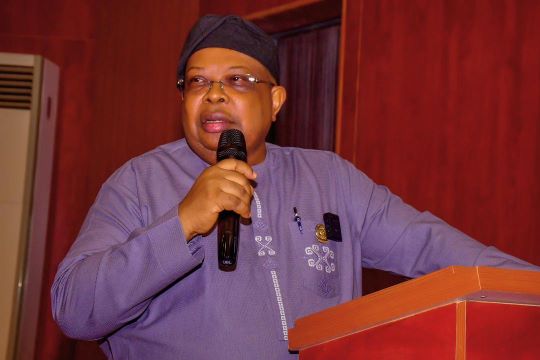
Minister of Power, Joseph Tegbe, has said that the Productive Use of Energy (PUE) agenda deserves collective attention as it sits at the intersection of energy, agriculture, industrialisation, financial inclusion,climate resilience, food security, rural development and job creation.
The Minister while commending the Rural Electrification Agency (REA) for conceiving and convening this highly strategic engagement, added that the country’s approach to energy diversification under the administration of President Bola Ahmed Tinubu, GCFR reflects a simple but profound truth that rural electrification is no longer about extending wires into communities but about extending opportunity.
“It is about creating prosperity. It is about enabling enterprise. It is about transforming electricity from a social service into an economic catalyst, Tegbe said at the workshop, championed by REA, which he said is another demonstration of that progressive thinking.He also acknowledged presence of the ECOWAS Commission, the Regional Off-Grid Electricity Access Project (ROGEAP), development partners, financial institutions, private sector participants, manufacturers, agricultural organisations, research institutions and every stakeholder who has committed time, expertise and resources towards this important national conversation.
According to him, When we speak about electricity, we often measure success by megawatts generated, kilometres of distribution lines constructed or the number of households connected. Those are important indicators. But they are not the ultimate objective. The true measure of success is what electricity enables. Certain questions, amongst others, that reflect new, audacious and creative thinking need to be asked and appropriately answered today . For example, can a farmer irrigate more land? Can a rice mill process more produce efficiently? Can a cold room preserve fish and vegetables? Can a cassava processor reduce waste? Can young entrepreneurs establish agro-processing businesses within their communities?”
The workshop he said should help galvanize thinking and provide conclusive answers to these questions because electricity, by itself, does not transform an economy.
Electricity becomes transformational only when it powers productivity.
In many respects, it is where multiple national priorities converge.
The Minister noted that Nigeria possesses one of Africa’s largest
agricultural economies acknowledging that farmers are industrious and out land is fertile; and our domestic market is vast, yet far too much agricultural value is still lost between harvest and market due to challenges that transcend agricultural into energy challenges.
“We lose crops because there is insufficient cold storage. We lose income because processing capacity remains inadequate. We lose jobs because raw produce leaves our farms without value addition. We lose competitiveness because production costs remain unnecessarily high. We lose opportunities because energy-intensive productive equipment remains beyond the reach of many rural enterprises.” he stressed.
These are exactly the challenges that Productive Use of Energy seeks to solve, Tegbe argues, adding “The business case is compelling. For farmers, energy-efficient equipment means lower operating costs, increased productivity and higher incomes. For financial institutions, it creates a new class of bankable productive assets capable of generating predictable cash flows and for equipment manufacturers, it opens an expanding domestic market driven by genuine demand.
For technology providers, it creates opportunities for innovation, localisation and after-sales services and for Government (at both state and federal levels), it stimulates local economic development, expands internally generated revenue, creates employment, improves food security, reduces post-harvest losses, strengthens rural economies and advances our commitments to sustainable development.
He encouraged that this workshop brings together policymakers, financiers, regulators, manufacturers, farmers, entrepreneurs and development partners under one roof.
The conversations over the course of the workshop must therefore be open, practical, evidence-based and must result in clear actions, he said and further encouraged every participant to engage constructively, challenge assumptions respectfully, share experiences openly and remain focused on solutions. Let us leave this workshop with greater alignment than we arrived with. Let us leave with renewed hope and confidence that Nigeria possesses both the vision and the capability to become Africa’s leading market for productive use of renewable energy in agriculture.
He congratulated the Rural Electrification Agency for providing the leadership to convene this important national dialogue and also extended profound appreciation to the ECOWAS Commission, ROGEAP, development partners, financial institutions, private sector organisations, farmers’ associations and every stakeholder represented here today.
“Your commitment demonstrates that the future of Nigeria’s energy transition will be built not by individual institutions working in isolation, but by partnerships united around a common purpose.” he said.
The Minister expressed confidence that the ideas generated will shape policies,
unlock investments, stimulate innovation and accelerate the deployment of energy-
efficient agricultural productive use equipment across our country.