

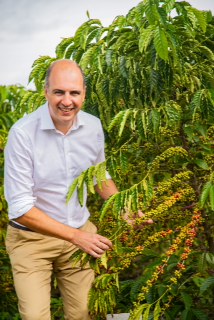
By Scott Coles,
There is nothing quite like that first cup of coffee in the morning. For me it’s a moment to gather my thoughts before the day really begins. However, this daily ritual isn’t something we can take for granted.
Climatologists have warned that without action, coffee farmers in Africa will lose their livelihoods. So, if we want to keep enjoying that precious cup, we need to ensure our coffee
is sustainably sourced.
Coffee farming in Africa
The continent produces 12% of the world’s coffee, with over ten million farmers across 30 countries. Whilst demand for coffee is forecast to grow significantly, crops have been declining in Côte d’Ivoire – the largest coffee producer in West Africa.
Nestlé has been manufacturing coffee in Côte d’Ivoire for over 60 years, and we have seen first-hand the challenges farmers are facing.
Climate change creates rising temperatures, drought and flooding which makes coffee more difficult to grow. Under this pressure farmers have turned to environmentally harmful practices such as deforestation and are substituting old coffee trees for crops which are easier to grow.
The case for sustainable coffee farming and transition to regenerative agriculture
It’s not too late to reverse this decline. On a recent farm visit to the village of Yobouekro, I saw for myself the impact climate change is having. I met with Amani Ahou, a female coffee farmer who, until recently planned to abandon her plantation as the crop from her aged trees had fallen to depressingly low levels.
Over the last few years, Amani has received training from Nescafé agronomists. She has learnt pruning techniques, composting and the importance of planting shade trees. She is now more upbeat about the prospect of reviving her coffee farm. ‘My plantation has rejuvenated, my old trees are starting to flower again, and are producing good coffee’, she said.
It was great to see for myself how improving technical knowledge, building stronger partnerships between farmers and industry can have a real and lasting impact for farmers like Amani.
Regenerative agricultural techniques like these play a critical role in the future of coffee farming. They will improve soil health, restore water cycles, increase biodiversity, and reduce greenhouse gas emissions. By planting more coffee trees and encouraging greater
biodiversity, farmers can create an environment for bees, insects and birds to thrive on their farms. This will have a positive impact on the ecosystem and reduce the effects of climate change.
The responsibility and cost for transitioning to regenerative agriculture cannot lie solely with the farmers. It’s been 10 years since we launched the Nescafé plan, during this time we have worked closely with farmers to improve agricultural practices, sharing our knowledge and expertise from across the planet. The plan builds farming skills to help farmers produce higher quality beans and achieve higher premiums, so they can support their families and contribute meaningfully to their local communities.
However, we know there is much more to be done, which is why we are going further and last week announced the Nescafé Plan 2030 to accelerate regenerative agriculture, reduce greenhouse gas emissions, and improve coffee farmers’ livelihoods.
Nescafé has committed to invest over 1 billion Swiss francs globally. The aims of the plan are:
- – 100% of our coffee to be sourced responsibly by 2025
- – 20% of coffee sourced from regenerative agricultural methods by 2025 and 50% by
2030.
In Côte d’Ivoire, we are committed to support farmers that take on the risk and costs associated with transitioning to regenerative agriculture. We will be piloting a financial scheme which includes conditional cash incentives for adopting regenerative agriculture practices.
We have a long way to go, but if the whole coffee industry in Africa supports this transition to regenerative agriculture, we will ensure no farmer is left behind, so we can continue to uplift lives and livelihoods with every cup we drink.
Scott Coles is the Coffee Business Executive Officer for Nestlé Central and West Africa
How Africa maximises its oil and gas riches
The energy crisis has underlined the global economy’s dependence on fossil fuels, and the call for more oil and gas supply has gone out. Africa stands ready to deliver. Last week at Africa Oil Week in Cape Town, Mansur Mohammed, Head of West Africa Upstream Content, and I scoped out the opportunity and the challenges for Africa’s upstream industry.
First, Africa has huge undeveloped resource, and no doubt more yet-to-find volumes. In the decade to 2020, 61 billion boe of conventional resource was discovered in Africa, almost twice as much as any other upstream region. Natural gas accounted for the bulk of these resources, much of it yet to be commercialised.
Exploration success has continued big time into the new decade with major deep water oil discoveries. Baleine (Eni) in 2021 is Côte d’Ivoire’s biggest ever and is already under development; Venus (TotalEnergies) and Graff (Shell), both this year, open up a new play entirely in Namibia. These three giant discoveries hold the type of low cost, low carbon-intensive barrels that the world needs.
Namibia could prove to be very extensive indeed. WoodMac’s current estimate for total reserves is 6 billion barrels; but the upside could be more than twice that dependent on future appraisal. TotalEnergies’ second well on Venus is planned for next year.
Second, upstream investment in Africa is on a strong upward trend. These big new discoveries feed into a healthy existing development pipeline which could drive a doubling of spend by 2025 from the regional lows of two years ago. With global spend showing little sign of growth, Africa is outperforming other upstream regions.
Moreover, investment is no longer dominated by Nigeria, Angola and the Congo. Much of the future spend will be in Uganda, South Africa, Senegal, Cote d’Ivoire, Mozambique and in all likelihood Namibia.
Almost half of projected spend beyond 2025 is slated for pre-FID projects. Uncommitted investment cannot be taken for granted. Allocation of capital is as ever vulnerable to the vicissitudes of commodity markets; while IOCs are sticking rigidly to tight capital discipline so far in this upcycle, preferring to return surplus cash to shareholders rather than invest in growth.
Above all, investors want to maximise the value of projects. A big part of that is process: minimising the lapse of time from discovery to first production and cash flow generation.
Third, governments have every motivation to expedite process. It’s not just the investment that can flow their way but the governments’ share of revenues. Upstream fiscal revenues in 2022 into the coffers of African producing nations will reach the highest level for a decade. Governments should be aiming to sustain and grow that income.
That’s about minimising bureaucracy to speed the process of permitting, licences and approvals; ensuring the supply chain and service industry are fit for purpose; building investor confidence through transparency, reputation and good governance; and incentivising investors with fiscal stability and clarity of terms.
Fourth, the corporate landscape in Africa is changing. The Majors continue to focus their global portfolios around advantaged assets – low cost, low carbon assets typically early in their life cycle – and selling mature, higher cost assets including legacy positions in Africa. This is a structural shift that’s been happening for a decade and will be ongoing. The good news is that there are buyers, mainly independents and indigenous players.
The ‘changing of the guard’ needn’t be seen as a bad thing – we’d argue that it’s better that the opportunities are in the hands of those that want to make the most of them. The resurgence in upstream investment suggests it isn’t holding Africa back.
Last, how do the bullish prospects for Africa’s upstream growth sit with net zero goals? The question is timely with COP27 taking place in a fortnight’s time on the continent at Sharm El-Sheikh in Egypt. We expect African countries, which together are responsible for just 4% of global annual emissions, will be adamant that their priorities are to develop fossil fuel resources to drive economic prosperity and bring affordable energy access to over 500 million people currently without electricity.
There is surely a win-win outcome. IOCs and other providers of finance can help develop Africa’s oil and gas resources, though most will only invest in projects that are aligned with their own net zero targets. That helps Africa to deliver the low cost, lower carbon oil and gas the world wants. Nor should projects be just about exports – developing domestic gas and power markets has to be part of national strategies and those of IOCs.
The longer-term future is all about low carbon energy. Many African countries have enormous solar and wind resource, some have plentiful hydro potential and nature-based solutions such as forests and soil farming too. There’s an opportunity for Africa to build a low carbon future around renewables, hydrogen, geothermal and CCUS, in parallel with the decarbonisation of fossil fuel developments.
The dual approach can drive economic growth, improve living standards on the continent and serve export markets.- Source: Wood Mackenzie