

Yemisi Izuora
Countries in Africa, especially oil producing nations are calling on Nigerian Government to create a cross border policy alignment to allow for more knowledge sharing that will help them achieve their goals in local content development.
Specifically, Ghana, and other African nations have underscored the growing influence of Nigeria’s local content framework and urged stronger cross-border policy alignment.
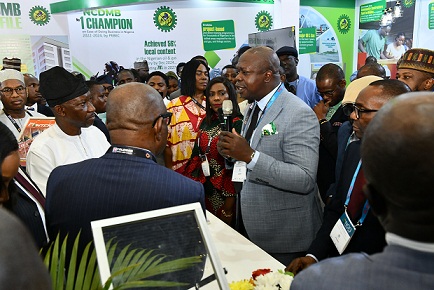
They spoke at the just concluded NOG Energy Week in Abuja, just as other indigenous oil companies applauded the initiative that has created more jobs in the country.
Ghana’s Deputy Chief Executive of the Petroleum Commission, Nasir Alfa Mohamed, noted that African nations have long looked to Nigeria for energy sector leadership. He called for dismantling barriers to regional integration and advocated for standardized regulations.
“A Ghanaian company should be able to compete for contracts in Nigeria based solely on merit,” Mohamed said. “We need joint regulatory bodies, mutual recognition of standards, and robust support for platforms like the African Oil Forum.”
Mohamed also highlighted Ghana’s growing partnerships with Nigeria and others, including a memorandum of understanding with Uganda. He noted that Ghana is currently the only African nation participating in the International Upstream Forum.
At the NOG Energy Week in Abuja, industry leaders robustly defended Nigeria’s local content policy, rejecting claims that it inflates business costs in the oil and gas sector.
They cautioned that such criticisms jeopardize the nation’s industrial progress and lauded the Nigerian Content Development and Monitoring Board (NCDMB) for its pivotal role in building indigenous capacity and fostering innovation.
During a panel session titled “Technology as a Business Strategy”, panellists championed NCDMB’s contributions, emphasizing its success in driving local expertise and technological advancement.
Dr. Daere Akobo, Group Chief Executive Officer of Pana Holdings, dismissed critiques of local content as arguing that its benefits to Nigeria’s economy far outweigh any perceived cost increases.
“Claims that local content drives up costs are misguided,” Akobo said. “How can you prioritize cost over GDP growth? Where will our youth find jobs? Undermining local content for short-term gains is a mistake. Nigeria must stay the course.”
Akobo highlighted his company’s work on Africa’s first digital refinery, a pioneering project showcasing the synergy between technology and local content. He identified fragmented data in Nigeria’s oil and gas sector as a key barrier to cost efficiency.
“Technology drives accountability and curbs cost inflation,” he said. “But our data remains siloed. Consolidating it is critical for industry efficiency.”
Mr. George Onafowokan, Managing Director of Coleman Cables and Wires, praised NCDMB’s data-driven approach, crediting it for significant strides in local content development.
“Data is the backbone of growth,” Onafowokan said. “Effective data collection and accessibility are vital. Thanks to NCDMB, we’ve achieved 52% local content—a remarkable milestone.”
The panellists unanimously agreed that integrating technology, consolidating data, and strengthening institutions like NCDMB are critical to building a resilient and competitive oil and gas sector. They urged policymakers, operators, and international stakeholders to reject narratives blaming local content for rising costs, advocating instead for robust frameworks and investments to drive inclusive growth and long-term industry stability.
Dr. Ernest Nwapa, NCDMB’s pioneer Executive Secretary, highlighted the Nigerian oil and gas sector’s resurgence, driven by increased production, deregulation, and improved governance. He emphasized the need for long-term sustainability to sustain this momentum.
“Africa is a cornerstone of Nigeria’s foreign policy,” Nwapa said, pointing to initiatives like the West African and African Gas Pipelines, the African Continental Free Trade Area (AfCFTA), and President Bola Ahmed Tinubu’s “Nigeria First, Africa Next” strategy as evidence of Nigeria’s continental commitment.
“When Nigeria enacted its local content law, it faced Western criticism from bodies like the WTO and EU, who labelled it anti-trade,” Nwapa recalled. “Today, over 16 African nations and even the United States have adopted similar laws. Nigeria must lead again, driving investments that benefit the entire continent.”
Engr. Farouk Ahmed, Authority Chief Executive of the Nigerian Midstream and Downstream Petroleum Regulatory Authority (NMDPRA), represented by Prof. Zainab Gobir, stressed the importance of joint infrastructure, uniform tariffs, and coordinated regulations for true economic integration.
“We must uphold our sustainability commitments and support each other in meeting them,” Ahmed said. He cited the Petroleum Industry Act (PIA) as a model, particularly its Midstream and Downstream Gas Infrastructure Fund, designed to de-risk investments in gas and infrastructure projects. Ahmed also highlighted NMDPRA’s efforts to streamline operations through a one-stop shop and ongoing stakeholder engagement.
“We collaborate closely with NCDMB to strengthen local content, ensuring regulations support fair participation,” he added.
Engr. Gbenga Komolafe, Chief Executive of the Nigerian Upstream Petroleum Regulatory Commission (NUPRC), reaffirmed Nigeria’s strategic role in regional energy cooperation, noting that the country accounts for nearly 30% of Africa’s oil reserves and 33% of its gas.
“Our host community development model is a success, fostering stability in oil-producing regions and serving as a blueprint for others,” Komolafe said. He highlighted NUPRC’s 17 forward-looking regulations and new frameworks for deepwater development, alongside a production optimization program built on inter-agency and operator collaboration.
Komolafe also praised President Tinubu’s recent Executive Order, which enhances local content laws by prioritizing human capacity development, boosting investor confidence.
“International oil companies now recognize Nigeria’s robust local expertise, making it a key investment draw,” he said. “We’re exporting our local content model to other African nations.”