

AP Report
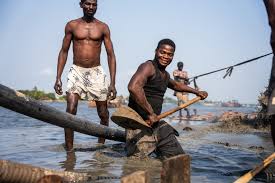
Beneath an eight-lane expressway, Nigerian men stand waist-deep in the Lagos Lagoon lowering buckets into murky water. Each load brings up sand, reshaping the coastline of Africa’s largest city and driving away fish and livelihoods for some of its poorest people.
Not far from the bridge, wooden boats are loaded with sand. One of thousands of local dredgers, Akeem Sossu, 34, has been diving for sand for at least three years. He slips beneath the surface for about 15 seconds at a time, hauling up bucketloads bound for construction sites.
Akeem said he and his partner earn about 12,000 naira ($8) each per boatload, selling to a middleman who supplies larger buyers. Filling a boat takes about three hours. Formerly a tailor, he said dredging now supports his household.
“I come out early, sometimes 5 a.m. or 6 a.m., depending on the tide,” he said.
Dredgers and local traders say the price of sand, crucial for making concrete, has risen steadily as development in Lagos has accelerated. A standard 30-ton truckload of what’s known as sharp sand — coarse and gritty — now sells for about 290,000 naira, or roughly $202, reflecting strong demand.
The changes to the lagoon that buffers the megacity of about 17 million people are unmistakable. What was once an open stretch of water is increasingly broken up by sandy patches, narrowing channels and reshaping currents that support thousands of fishermen.
The transformation is most visible near Makoko, one of Lagos’ oldest fishing communities. Dredging barges operate close to homes built on stilts, while reclaimed land and construction of upscale beachfront properties press in from the edges. Residents say the encroachment has destroyed fishing grounds and put many out of work.
Nearby, fishermen wait for the day’s dredging to pause. They say that when it does, even briefly, some fish return.
A city built on sand
Lagos, Nigeria’s economic engine, is in constant construction. Roads, bridges and housing estates are rising daily on reclaimed waterfronts as the city’s rich displace many of its poor.
Over the past five years, dozens of registered dredging firms and numerous informal operators have sprung up or increased their operations, extracting sand from rivers and coastal waters across Lagos State.
Industry analysts estimate the city consumes tens of millions of cubic meters of sand each year, an amount roughly equivalent to 16,000 Olympic-sized swimming pools.
Lagoon sand is particularly prized by builders, who say it produces stronger concrete than sand that is dredged inland.
Fishermen and environmental researchers say the cost of that demand is increasingly visible in the water.
Driving fish away
Traditional leader of Makoko, Baale Semede Emmanuel stands outside his home in the coastal community of Makoko, Saturday, Dec. 13, 2025, in Lagos Nigeria. (AP Photo/Grace Ekpu)
“We are not powerful,” said a community leader of Makoko, Baale Semede Emmanuel. “Dredgers have spoiled the entire waters.”
Fishermen there say dredging has wiped out shallow areas where fish once spawned before moving into deeper waters. At times, fish are sucked through dredging pipes.
“Anywhere dredging is happening, there’s no fish,” Emmanuel said. “The noise drives them away. The places where they used to reproduce are gone.”
With catches shrinking, fishermen say they must travel farther offshore, increasing fuel costs and exposure to rougher seas. Some have stopped fishing altogether.
“We have no other work apart from fishing,” Emmanuel said. “If we don’t find fish, we will starve.”
Pushed from the water
For some fishermen, dredging has forced an uneasy shift away from the sea. Joshua Monday said he has largely parked his two fishing boats and now works as a mechanic.
He learned how to fix boat engines years ago as a backup.
“If not for this mechanic work, I don’t know how I would survive,” he said.
He said rising costs and shrinking catches have made fishing untenable. Fuel can cost more than 150,000 naira ($104) for a single trip, he said, with no guarantee of a return.
“Sometimes you go to the sea and come back with nothing,” he said. “All the fuel is gone.”
Meanwhile, he said, wealthy developers and other powerful interests are reclaiming land around Lagos while fishermen are pushed aside.
“Big men are stressing us,” Monday said. “When they come, you have no option. You pack your things and leave.” He now lives in another waterfront community under pressure, Sagbo-Koji.
Making money from sand
Worker shovels up freshly extracted sharp sand from a dredging transporter in Ibeshe, Lagos, Nigeria, on Saturday, Dec. 6, 2025. (AP Photo/Grace Ekpu)
Dredgers say the work offers rare income in a city with limited opportunities.
“I’m a father of one,” said Joshua Alex, a dredging operator. “This is how I take care of myself.”
He explained how informal dredgers interact with authorities and pay their “dues” to stay in business.
“Marine Police will come, we settle them. NIWA will come, we settle them,” he said, referring to the National Inland Waterways Authority. He said the payments make the work legitimate.
Environmental advocates say such arrangements blur the line between legal and illegal dredging, allowing operators to resume work shortly after enforcement actions.
Government warnings, limited regulations
Lagos State officials, including Gov. Babajide Sanwo-Olu, have repeatedly pledged to clamp down on illegal dredging, especially operations that are blamed for worsening flooding, erosion and other environmental degradation along the coast.
The government says it has shut down sites operating without permits and strengthened monitoring through waterfront and environmental agencies. The Lagos State Ministry of Waterfront Infrastructure Development didn’t respond to questions.
But community leaders say enforcement is inconsistent, pointing to the payments by informal dredgers.
“When the government stops dredging activities today, they get paid, and then they ask them to resume activities,” said the Makoko community leader, Emmanuel.
He accused authorities of prioritizing revenue and private development over the survival of fishing communities, citing land allocations for real estate projects along the waterfront.
“The government has the power, not us,” he said.
What the science says
Aerial view of sand dredging near Makoko, a fishing settlement across the third mainland bridge, Lagos, Nigeria, on Saturday, Dec. 6, 2025. (AP Photo/Grace Ekpu)
Scientific research supports fishermen’s claims about the impacts of dredging in Lagos.
Peer-reviewed studies by Nigerian scholars conducted along the Ajah–Addo-Badore corridor, a major dredging zone east of Makoko, found water turbidity levels far above national safety standards, conditions that disrupt fish feeding, reproduction and migration.
Researchers also documented unstable seabeds and erosion-prone zones beneath dredging sites, and more stable conditions where dredging was absent. In some locations, groundwater samples showed bacterial contamination linked to human waste.
Scientists have warned that dredging reduces the lagoon’s ability to absorb floodwaters, increasing long-term risks for Lagos and its population. Wetlands and shallow lagoon areas act as natural buffers. When they are removed or destabilized, communities become more vulnerable.
Lagos has experienced increasingly severe flooding in recent years, with waterfront and low-lying neighborhoods among the hardest hit