

Yemisi Izuora
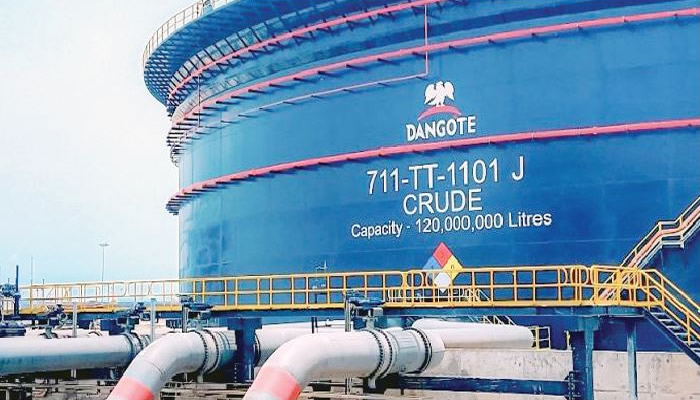
Dangote refinery is though seen as widely benefiting from Middle East tensions, analysts however considers its expansion as providing further revenue opportunities in the near future.
The refinery’s plan to double capacity to 1.4 million barrels per day is emerging as a key factor in the plant’s long-term valuation, as analysts weigh the benefits of structural cost advantages against the risk that refining margins normalize from recent highs.
The management has said it is working on an expansion from 700,000 barrels per day to 1.4 million barrels per day, while also targeting an increase in polypropylene capacity to approximately 2.4 million tonnes per annum. That second phase, according to Renaissance Capital Africa, could become one of the single biggest drivers of value for the business.
But speaking in a CNBC Africa interview, Divine Olumese, oil and gas analyst at Renaissance Capital Africa, stressed that the refinery’s recent margin strength was supported by stronger crack spreads and geopolitical tensions.
“The higher margins that we’ve seen recently is as a result of the higher crack spreads that we’ve seen and also relating to the tensions that we’ve seen in the U.S. and Iran,” Olumese said.
He said Dangote Refinery posted gross refining margins of about $24.5 per barrel in the first quarter, reflecting the stronger market backdrop during the period.
That matters for investors because current earnings support can boost sentiment in the near term, even as the more consequential valuation debate centers on what the refinery could earn once a second expansion phase is delivered.
Renaissance Capital Africa said its valuation is highly sensitive to the timing of phase two commissioning. Olumese said the firm’s base case assumes commissioning in 2030, while its bear case assumes 2031 and its bull case assumes 2028.
Using that framework, the bank arrived at a fair value of 47 U.S. cents per share, equivalent to around 622 naira, with a valuation range of 45 cents to 52 cents depending largely on execution timing. Based on a current level of 525 naira, that implies about 22 per cent upside in the base case.
Olumese said that upside is supported by what he described as Dangote Refinery’s structural advantages relative to peers globally.
“We believe that it’s justified given the structural advantages that Dangote refinery enjoys compared to other refineries around the world,” he said.
Those advantages are central to the investment case. Large, integrated refineries can benefit from scale, logistics efficiencies and product diversification, especially when they are able to process crude and sell refined products and petrochemicals into large domestic and regional markets.
For Dangote Refinery, the ability to expand not only fuels output but also polypropylene production strengthens the argument that value creation may extend beyond a simple refining story.
Still, the interview also underscored the key risk hanging over bullish assumptions: refining margins may not remain at elevated levels indefinitely. Margins have been helped recently by stronger crack spreads, which measure the difference between the price of crude oil and refined products such as gasoline and diesel. Those spreads can widen during periods of supply disruption, stronger product demand or geopolitical stress, but they can also compress when markets normalize.
That leaves investors balancing two moving parts at once. The first is the near-term earnings backdrop, which has been helped by supportive refining economics. The second is the timing of expansion, which could materially alter the refinery’s earnings power later in the decade.
In that sense, the project’s second phase carries unusual weight in valuation work. If commissioning comes earlier, the market may be willing to assign greater value to future cash flows, especially if the business can sustain a cost edge over global rivals. If the buildout slips, however, some of the expected upside could be deferred, particularly in an environment where refining margins retreat from current levels.
Olumese’s comments suggest that investors looking at a potential public market valuation are effectively being asked to think several years ahead. While recent profitability offers a snapshot of operating momentum, the bigger question is how much investors should pay today for earnings that may only fully materialize once expanded capacity comes onstream.
That is why the 2028, 2030 and 2031 commissioning scenarios matter so much in the bank’s framework. A 2028 outcome would likely support the upper end of Renaissance Capital Africa’s valuation range, while a 2031 scenario would point to the lower end. The spread between those outcomes illustrates how execution, rather than just commodity prices, may determine whether the refinery unlocks its next major leg of value.
The expansion story also comes at a time when African energy infrastructure assets are drawing closer scrutiny from investors looking for scale, import substitution potential and regional supply advantages. Dangote Refinery, by virtue of its size and integration, sits at the center of that conversation.
For now, analysts appear to be anchoring their expectations on a combination of strong current margins and long-dated expansion potential. The next major catalyst for the valuation debate is likely to be clearer guidance on execution milestones for phase two, including whether the refinery can move toward the more optimistic end of projected commissioning timelines.
If it does, the expansion could become not just an operational milestone, but the next major value driver investors have been waiting for.