

Uche Cecil Izuora
Governments push to reduce the number of vehicles running on Premium Motor Spirit (PMS) also called petrol with the introduction of Compressed Natural Gas (CNG) has remained an illusion due to cost factor among others.
According to report the cost for private vehicles to switch is 20 times Nigeria’s minimum monthly wage of $42.
Despite Government ending costly petrol subsidies that made petrol very expensive most commercial vehicles operators knew conversion to CNG was illusory.
Transportation costs skyrocketed as the price of petrol more than tripled in the months that followed last year’s decision to end subsidy resulting in the country’s worst cost-of-living crisis in a generation.
A report by Associated Press (AP) which interviewed a transporter showed some degree of uncertainty over how people can raise required capital to switch to CNG.
The AP report concentrated on Ahmed Halilu who knew his e-hailing cab business in Abuja, was about to run into huge losses.
That meant a massive drop in the number of Halilu’s passengers and ultimately in his earnings.
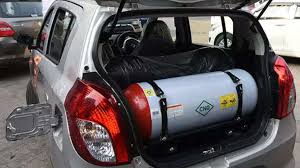
In what they said would eventually lower transportation costs by almost 50 per cent, Government in August introduced CNG initiative to tap its huge gas reserves, Africa’s largest and roll out CNG buses while switching petrol-powered vehicles to use it.
More than 100,000 vehicles have been adapted to run on CNG or with the hybrid option of CNG and petrol, and at least $200 million has been invested by the Government under the initiative, according to its director, Michael Oluwagbemi.
The Government aims to convert 1 million of Nigeria’s over 11 million vehicles in the next three years, but analysts say the process has been slow, pointing to poor implementation and limited infrastructure.
Although Nigeria is one of Africa’s top oil producers, it depends on imported refined petroleum products because its refineries are struggling with production at its lowest in decades amid massive oil theft.
Together with other reforms introduced by President Bola Tinubu after coming to power in May last year, the removal of subsidies was supposed to save the government money and shore up dwindling foreign investments.
However, it has affected the price of just about everything, and soaring transportation costs force people to abandon their vehicles and walk to work.
Switching over to gas is hard. In addition to the lack of an adequate network of CNG conversion and filling stations available in 13 of Nigeria’s 36 states the success of the government’s initiative also has been limited by low public awareness.
That has left room for misinformation and hesitancy among drivers.
“People are not keen about it because of a lack of orientation,” Halilu said. He converted his vehicle and now saves $240 monthly on petrol costs in his e-hailing business.
Some drivers have expressed fear that their cars could explode with the CNG conversion claims that regulatory agencies have said are untrue unless the equipment is installed inappropriately.
In southern Edo state, authorities found that a CNG-powered vehicle that exploded had been worked on by a unaccredited vendor.
Even in Abuja and the economic hub of Lagos, filling stations are scarce and the few available conversion workshops are often lined with commercial vehicles waiting for days to switch to CNG at subsidized rates.
A colleague had to travel about 200 kilometers (124 miles) to Abuja to refill his cylinder, said Abdul Manasseh, an e-hailing taxi driver in Abuja.
Another challenge that has slowed the initiative is Nigeria’s limited gas pipeline, which makes supplying stations difficult. As a result, most parts of the northern and eastern states have not been reached.
The challenges echo those for the shift to electric vehicles in Nigeria, where the adoption by private operators has been slow.
The power supply remains fitful for most of the country’s 210 million citizens, mainly as a result of underinvestment and vandalism.
The government understands there is still “a lot of uncertainty” around the CNG initiative and is working to correct the misconceptions and provide the needed infrastructure, said Tosin Coker, the initiative’s head of commercial matters.
“CNG is a cleaner fuel, it is a cheaper fuel and it is a safer fuel compared to the petrol that we are used to,” Coker said. “So you will have more money in your pocket and it’s cleaner for the environment?