

Yemisi Izuora
S&P Global Ratings has cited Dangote’s planned expansion to 1.4 million barrels a day as evidence the refinery has become structurally relevant to Nigeria’s external balance, not just its energy sector.
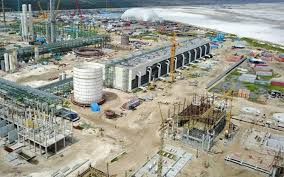
The rating Agency raised Nigeria’s long-term sovereign credit rating to B from B- on May 15, granting Africa’s most populous nation its first upgrade in 14 years and elevating Aliko Dangote’s $20 billion refinery to the rank of a country-shaping economic asset.
The Agency tied the decision to four pillars: higher oil production, the 2023 liberalisation of the naira, tighter capture of petroleum revenues, and the ramp-up of Dangote Industries Ltd.’s refining and petrochemical complex to near its 650,000 barrel-a-day capacity.
Gross foreign-exchange reserves climbed to $50 billion by early March 2026 from $33 billion in 2023, while the current-account surplus is projected at 5.8 per cent of GDP this year, according to the rating report.
“Domestic supply helps ensure the availability of refined fuel, gas, and fertiliser for the Nigerian market, providing a buffer against the global and regional supply constraints caused by the Middle East conflict,” S&P said in the report.
That framing marks the first time a global rating agency has elevated a private African industrial asset to the status of a macroeconomic stabiliser. For Nigeria, which once spent close to $10 billion a year importing refined fuel, the shift relocates part of its sovereign creditworthiness onto a single privately owned plant in Lekki, east of Lagos — a concentration of risk and reward with few continental precedents.
Industry data confirm the magnitude of the substitution.
The Dangote complex sourced roughly two-thirds of its crude from domestic fields in 2025, thereby cutting Nigeria’s refined-product import bill, and began exporting petrol and diesel to West African and Atlantic markets, according to the S&P report. Other Agencies have moved in the same direction: Fitch Ratings raised Nigeria to B in April 2025, Moody’s Investors Service lifted it to B3 from Caa1 in May 2025, and Chinese agency Dagong Global Credit Rating already rates the country BB+, two notches above its Western peers.
The good news stops at the pump. S&P warned that the refinery is unlikely to ease retail fuel prices because Nigerian pump prices now track global benchmarks and the plant still imports blending crudes as part of its feedstock. Petrol and diesel prices have climbed several times at Nigerian filling stations since the Middle East conflict erupted in February 2026, the agency noted. The country is becoming a refining power without protecting its own consumers.
The World Bank’s April 2026 Nigeria Development Update found that the share of Nigerians living below the national poverty line rose to 63 per cent in 2025 from 56 per cent in 2023, equivalent to roughly 140 million people, even as headline inflation fell from 34.8 per cent in December 2024 to 15.15% a year later. “Household incomes have not grown fast enough to offset still-elevated inflation, and poverty has yet to begin declining,” the World Bank stated in the report.
The International Monetary Fund has been more cautious than S&P on the cyclical picture. The IMF cut its 2026 growth forecast for Nigeria to 4.1% from 4.4% at its Spring Meetings in Washington. Deniz Igan, a division chief in the IMF’s Research Department, said at the April press briefing that war-related fuel, fertiliser and shipping costs would erode non-oil activity. S&P, by contrast, raised its Brent crude price assumption to $100 a barrel for the rest of 2026, a hypothesis that is critical to its upgrade arithmetic.
Hidden liabilities also shadow the upgraded sovereign. S&P includes in Nigeria’s debt stock a $5 billion swap facility signed with First Abu Dhabi Bank PJSC, collateralised at 133% with local-currency bonds. It also notes that about 200,000 barrels a day of crude are pledged under separate financing arrangements by state-owned NNPC. The agency further flagged fiscal and external data that remain prone to “errors, omissions, and large frequent revisions” — an unusually candid warning from a body that has just lifted the rating.
Politics will test the trajectory before the macro framework can. The general government deficit is projected to widen to 4.2 per cent of GDP in 2026 and 4.1 per cent in 2027 from 3.0 per cent in 2025, as President Bola Tinubu’s administration accelerates capital spending ahead of the January 2027 election.
The 2026 budget earmarks 32.2 trillion naira ($23 billion) for capital expenditure, equivalent to 7.3 per cent of GDP, according to the budget document signed in April. A reintroduction of fuel subsidies — explicitly ruled out by the government for now — would be enough to reverse the upgrade.
Dangote’s feasibility study for the 1.4 million-barrel-a-day expansion, the Central Bank of Nigeria’s next monetary policy decision, and the 2027 election campaign opening three timelines that will decide whether one refinery in Lekki can keep carrying a country of 220 million.