

By PR Newswire
Nigeria’s local content story has evolved significantly over the past two decades. What began largely as a regulatory response to the country’s dependence on foreign multinationals, imported expertise and overseas fabrication has developed into a more deliberate strategy for building domestic capability. The focus is no longer simply on increasing Nigerian participation in the oil and gas industry. It is increasingly about developing resilient businesses, strengthening technical expertise and expanding the industrial capacity required to deliver complex projects locally.
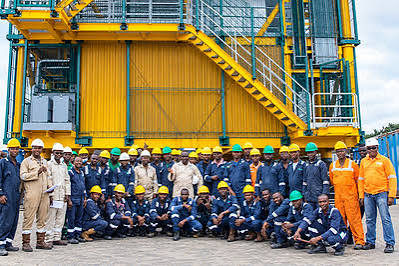
Industrial Crew Portrait at a Rig Module
For years, international operators such as Shell, Chevron and ExxonMobil played a central role in shaping the pace and scale of exploration, production, and export activities in Nigeria. As local participation expanded, however, the focus increasingly shifted beyond simply having Nigerian companies involved to developing the technical skills, infrastructure and industrial capabilities needed to retain more of the value chain within the country. The passage of Nigeria’s Local Content Act in 2010 formalised this direction, creating a framework for greater participation by Nigerian companies and professionals in the oil and gas industry.
Today, Nigerian companies are fabricating major components, supplying equipment and services, training engineers and technicians, and taking on increasingly complex work across the energy value chain. This progress is reflected in data from the Nigerian Content Development and Monitoring Board (NCDMB) which reported that Nigerian Content reached 56% at the end of 2023, up from less than 5% in 2010. The Board has also reported that implementation of the Nigerian Oil and Gas Industry Content Development (NOGICD) Act has created over 50,000 direct jobs and enabled more than $8 billion in annual oil and gas expenditure to be retained within the Nigerian economy.
This progress raises a more important question for the next phase of Nigeria’s industrial development: What happens when local content moves from a requirement for participation to a platform for building lasting national capability?
This is a challenge that other resource-producing countries have also sought to address. Brazil, for example, used local-content requirements to increase domestic procurement and support job creation, technology transfer and the development of local supplier chains. Malaysia’s PETRONAS similarly operated vendor-development programmes focused on strengthening the technical and commercial capabilities of local oil and gas suppliers, helping them compete beyond the domestic market. Ghana’s local-content framework also places specific emphasis on technology and skills transfer to indigenous companies.
From Engineering Heritage to Industrial Capability
Dorman Long Engineering’s history offers a useful perspective on Nigeria’s industrial development. Established in 1949, the company has been involved in some of the country’s major infrastructure and industrial projects over more than seven decades. Its historical work has included railway projects, warehouses for companies such as UAC and PZ, and the first Niger Bridge.
Its entry into the oil and gas sector in the 1990s marked an important stage in that evolution. Following an introduction by the then Nigerian National Petroleum Corporation, the company began working with Shell in 1994 on pressure vessels, manifolds and separation packages. Its subsequent work has included components and structures associated with major offshore developments such as the Agbami and Akpo FPSOs, alongside engineering, procurement and asset-management services. These projects reflect a broader shift in what indigenous companies are able to undertake within the energy value chain, moving from supplying basic services towards developing the technical and fabrication capabilities required for more specialised work.
That industrial capability has been complemented by a sustained focus on developing the people needed to support it, including through partnerships with the Nigerian Content Development and Monitoring Board (NCDMB) and the Nigerian Society of Engineers (NSE).
In 2017, Dorman Long trained 78 Nigerians in Non-Destructive Testing and Project Management through a 12-week programme sponsored by Hyundai Heavy Industries. The trainees were divided between 39 people trained in Non-Destructive Testing (NDT) and 39 trained as Project Management Professionals.
The same approach extended beyond project-based training. Between August 2021 and August 2022, Dorman Long, in partnership with Shell Petroleum Development Company, trained 40 young people from the Assa North and Ohaji South communities in Imo State. Eight participants received professional training, while 32 underwent vocational training in areas including electrical engineering, welding and fitting, scaffolding and rigging, project management, electrical installation, civil engineering, quantity surveying, ICT and telecommunications, and carpentry. The programme combined classroom learning with practical experience, equipping participants with skills that could be applied within the industrial workforce or used to pursue self-employment.
Similarly, in 2025, the company signed an MoU with NSE covering training, consultancy and human-capital development. The agreement includes structured training for NSE student members and a one-year training programme with stipends for graduate members.
For an economy where young people entering the labour market often face a gap between academic qualifications and industry-ready skills, capacity building offers value beyond filling immediate vacancies. In a country with a population exceeding 230 million, local-content initiatives, particularly in capital-intensive sectors such as energy and engineering, can create opportunities for young Nigerians to acquire the technical skills and practical experience needed to participate in industrial development.
In line with the NCDMB’s 19-year Strategic Roadmap which sets out an ambition to increase Nigerian Content to 70% by 2027, companies such as Dorman Long Engineering illustrate how this ambition can translate into practice through indigenous engineering and fabrication, technical talent development and the capacity to undertake increasingly complex work locally.
Ultimately, the long-term value of local content will depend not only on the proportion of work undertaken by Nigerian companies, but also on the technical expertise developed, the industrial capabilities built and the value retained within the economy. By strengthening domestic suppliers, investing in skills and expanding the scope of work that can be delivered locally, Nigeria can move beyond participation towards building a more resilient industrial base.