

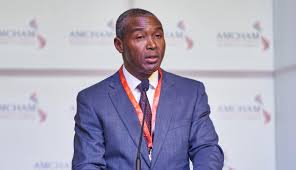
Yemisi Izuora
Former Managing Director of the Nigeria LNG, Philip Mshelbila, has said that Nigeria is better positioned to make significant revenue from global gas scale up arising from the Middle East conflict.
Mshelbila, who is currently the Secretary General of the Gas Exporting Countries Forum (GECF),, said Africa had a role to play in meeting demand with flows from the Middle East constrained, noting the giant gas reserves held across Algeria, Libya, Egypt, Nigeria, Mozambique and others.
According to him, Nigeria alone has reserves of 209-600 trillion cubic feet of natural gas, he said.
While addressing an Africa-focused energy conference in Paris, Mshelbila, said,
“For Africa’s gas exporting countries, tighter global gas prices are creating opportunities,” he said. But he noted that the continent is currently producing just 40 per cent of its total capacity, with LNG facilities and pipelines across Africa not full.
“The reserves are there, the production is not,”. “The ability therefore to capture the market, whether it is European or Asian, in the short term is being missed. This is a missed opportunity which is actually being seized by North America, principally the US and Canada.”
As a result, he implored African countries to encourage upstream investment, build interconnected regional cross-border pipeline systems, add value through gas processing and petchem facilities and expand cross-border LPG infrastructure.
Nigeria LNG Limited (NLNG) is actively expanding production through its $10 billion Train 7 project, aiming to boost capacity by 35% from 22 million tonnes per annum (mtpa) to over 30 mtpa. This expansion, which includes significant debottlenecking of existing trains, reinforces Nigeria’s global LNG position and supports a national target of 10 billion scf of gas production by 2030
The Train 7 project, which is nearing completion, adds a new liquefaction train and debottlenecks existing infrastructure to increase total capacity to over 30 mtpa.
The expansion is designed to enhance Nigeria’s ability to meet rising global demand, particularly in Europe and Asia, following supply disruptions.
The investment involves partners NNPC Ltd., Shell Gas BV, TotalEnergies, and Eni International.
Beyond Train 7, stakeholders are discussing further expansion with additional LNG trains and upgrading pipeline infrastructure like the OB3 project to bolster gas supply.
The expansion is part of Nigeria’s “Decade of Gas” policy, aiming to maximize the utilization of over 210 trillion cubic feet of proven gas reserves.