

Agency Report
- Sacrifice zones are places where big business and transnational corporations contaminate rivers, air, waters and soil for profit, while the price is paid by local communities suffering degradation of their health and ecologies.
- “To dismantle sacrifice zones, governments and corporations must prioritize people over profit, implement robust environmental safeguards, and respect the rights and autonomy of affected communities,” a new analysis argues, with examples of four places across the world.
- This article is an analysis. The views expressed are those of the author, not necessarily Mongabay.
See All Key Ideas
Across continents, “sacrifice zones” resemble wounds carved deep into the fabric of our planet. These are regions where ecosystems and livelihoods have been ravaged by fossil fuel and other industries that promise progress but leave devastation in their wake. These are places where big business and transnational corporations are contaminating the rivers, darkening the skies, and making the soil barren; where the toll of development is paid in human suffering and ecological destruction.
What unites these “sacrifice zones” is the shared story of areas where prosperity for the few is built on the suffering of many, and where communities fight to mend the fractures inflicted upon their land, health and dignity.
Here are four case studies highlighting the experiences of communities and civil society organizations that collaborate with the program I coordinate, the Coalition for Human Rights in Development’s Community Resource Exchange.
Odimodi, Nigeria
The Niger Delta stands as one of the most polluted regions in the world due to decades of environmental destruction caused by oil companies. Among the most prominent culprits are Shell Petroleum Development Company of Nigeria (SPDC), its U.K.-based parent company Shell plc, the Nigerian National Petroleum Corporation (NNPC), TotalEnergies of France, and the Nigerian Agip Oil Company (a subsidiary of Italy’s ENI). These corporations have devastated the livelihoods of communities like Odimodi, home to approximately 5,000 residents, by spilling crude oil, discharging toxic effluents, and gas flaring.
An oil spill in August 2022 in Odimodi exemplifies the ongoing environmental crisis which, in a decades-long pattern, led to significant habitat destruction and the loss of fishing and farming — the lifeblood of the community. The waterways remain heavily contaminated, forcing fishers to travel farther out to sea for diminishing catches, often at great personal risk. Exemplifying their powerlessness, one community member laments, “The fish we eat right now smell of crude in their intestines, smell of crude in their gills. And most times, we eat them because we have no option.”
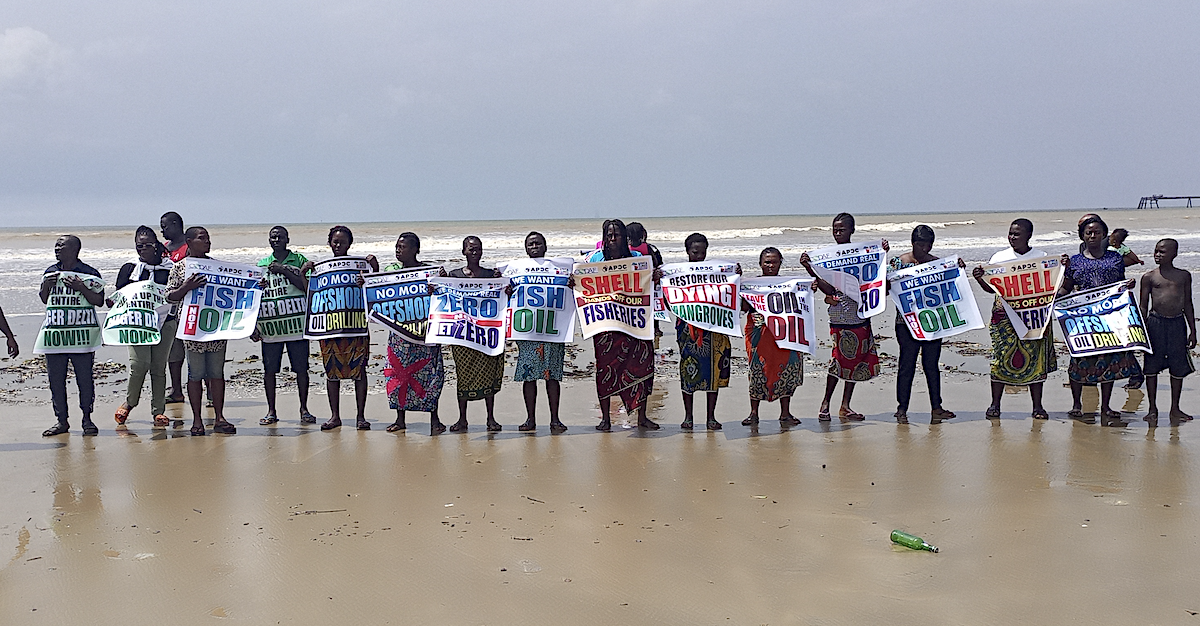
Grassroots organizations such as the Community Development Advocacy Foundation (CODAF) and Environmental Rights Action/Friends of the Earth Nigeria (ERA/FoEN) actively support the Odimodi community. Image via the Coalition for Human Rights in Development.
Women bear the brunt of this ecological disaster as they face heightened poverty and are systematically excluded from decision-making processes to address the crisis. Despite these challenges, oil companies routinely deploy “divide and rule” tactics, using financial inducements to weaken community solidarity and obstruct meaningful action.
The impacts of these spills extend far beyond immediate economic losses. Odimodi residents lack access to clean water, and their farmlands have become infertile, plunging the community into deeper poverty. Health outcomes have deteriorated due to prolonged exposure to polluted environments. In one account, a community member says, “There are a lot of cases of asthma because of inhalation of the crude. There are a lot of skin diseases, a lot of miscarriages. This is documented evidence that you can find in the community health center.”
Meanwhile, Shell and its Nigerian subsidiary, which have operated in the region since the 1950s, are attempting to offload their onshore oil assets without adequately addressing the catastrophic environmental damage they caused. This is a recurring strategy to escape accountability while leaving behind rusting pipelines, leaky infrastructure and toxic landscapes.
Grassroots organizations such as the Community Development Advocacy Foundation (CODAF) and Environmental Rights Action/Friends of the Earth Nigeria (ERA/FoEN) are actively supporting communities like Odimodi by providing legal counsel and amplifying their voices in calls for justice. While the Nigerian Supreme Court recently permitted Shell to proceed with its asset sale, advocates demand the company fully remediate the land and waterways and compensate affected residents before exiting.
Odimodi’s plight exemplifies the deep inequalities and systemic failures perpetuated by transnational oil corporations and weak regulatory frameworks. As an activist from CODAF says, “Governments who are supposed to be regulators to regulate the activities of these oil industries [turn] blind eyes and deaf ears to the situation … the oil industry pays the bills of the regulators.” In this way, vulnerable communities are left to bear the devastating costs.
Corporations have impacted the health and livelihoods of communities like Odimodi by spilling crude oil and gas flaring, activists say.