

Agency Report
The U.S. capture of Venezuelan leader Nicolas Maduro – praised by President Donald Trump as stunning and powerful – leaves behind uncertainty about who is running the oil-rich country.
Trump said on Saturday that Vice President Delcy Rodriguez, part of the powerful cabal at the top of the country’s government, had been sworn in after Maduro’s arrest and that she had spoken with U.S. Secretary of State Marco Rubio, leading to speculation that she would take the reins.
Under Venezuela’s constitution, Rodriguez becomes acting president in Maduro’s absence and the country’s top court ordered her to assume the role late Saturday night.
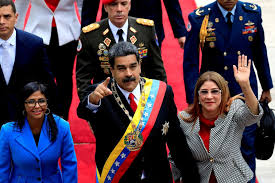
But shortly after Trump’s remarks, Rodriguez appeared on state television flanked by her brother, the head of the national assembly Jorge Rodriguez, Interior Minister Diosdado Cabello and Defense Minister Vladimir Padrino Lopez and said that Maduro remained Venezuela’s only president.
The joint appearance indicated the group that shared power with Maduro is staying united – for now.
Trump publicly closed the door Saturday on working with opposition leader and Nobel Prize winner Maria Corina Machado, widely seen as Maduro’s most credible opponent, saying she doesn’t have support inside the country.
After Machado was barred from running in Venezuela’s 2024 elections, international observers say her stand-in candidate won the vote in a landslide, despite Maduro’s government claiming victory.
CIVILIAN-MILITARY POWER BALANCE
For more than a decade, real power in Venezuela has been held by a small circle of senior officials. Analysts and officials say though that the system depends on a sprawling web of loyalists and security organs, fueled by corruption and surveillance.
Within the inner circle, a civilian-military balance reigns. Each member has their own interests and patronage networks. Currently Rodriguez and her brother represent the civilian side. Padrino and Cabello represent the military side.
This power structure makes dismantling Venezuela’s current government more complex than removing Maduro, according to interviews with current and former U.S. officials, Venezuelan and U.S. military analysts and security consultants to Venezuela’s opposition.
The U.S. government has no right to go into a sovereign country and basically openly say, We’re going to take the oil, we’re going to take the gold,
“You can remove as many pieces of the Venezuelan government as you like, but it would have to be multiple actors at different levels to move the needle,” said a former U.S. official involved in criminal investigations in Venezuela.
A big question mark surrounds Cabello, who exerts influence over the country’s military and civilian counterintelligence agencies, which conduct widespread domestic espionage.
“The focus is now on Diosdado Cabello,” said Venezuelan military strategist Jose Garcia. “Because he is the most ideological, violent and unpredictable element of the Venezuelan regime.”
The United Nations found both SEBIN, the civilian agency, and DGCIM, the military intelligence service, have committed crimes against humanity as part of a state plan to crush dissent. Eleven former detainees – including some who were once security personnel themselves – described electric shocks, simulated drownings, and sexual abuse at DGCIM black sites to Reuters in interviews before Maduro’s capture.