

Uche Cecil Izuora
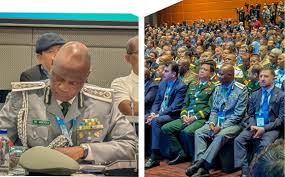
The Nigeria Customs Service has supported a new phase of global security cooperation, with Comptroller‑General of Customs Adeniyi representing the Service at the 19th Defence Services Asia Exhibition and Conference (DSA 2026) in Kuala Lumpur. The event, hosted at the Malaysia International Trade and Exhibition Centre (MITEC) on 21 April 2026 and inaugurated by Malaysian Prime Minister YAB Dato’ Seri Anwar Ibrahim, brought together more than 1,400 firms and security officials from across defence, cybersecurity, and border‑security domains.
At the Police–Private Security Dialogue on Cross‑Border Crime and Transnational Networks, a key track under the Asia Pacific Security Association Malaysia International Security Summit (AMISST) 2026, Adeniyi warned that isolated, nationally confined enforcement responses are no longer adequate. Speaking to security chiefs from 14 countries, he argued that networks dealing in drugs, illicit wildlife trade, financial fraud, and terrorism‑linked financing are highly integrated and fluid, often moving seamlessly across jurisdictions. Enforcement, he said, must mirror this integration through coordinated intelligence‑sharing, joint operations, and harmonised legal frameworks.
The CGC cited the NCS’s three‑pillar strategy of technology, collaboration, and capacity as a model that other administrations can adapt. He stressed that frontline officers need modern scanning and inspection tools, digital risk‑profiling systems, and real‑time data platforms to detect and intercept illicit flows. At the same time, customs authorities must deepen partnerships with banks, logistics firms, ports, and other regulatory agencies, creating a layered security architecture rather than siloed interventions.
Adeniyi reiterated the relevance of the World Customs Organisation (WCO) instruments, which guide member states in aligning procedures, securing supply chains, and countering emerging threats. He pointed out that criminal patterns originating in one region frequently ripple through global markets, making it imperative for enforcement agencies worldwide to act in concert rather than in isolation. Conference participants echoed this view, identifying constraints such as staff shortages, legacy systems, and the rapid pace of technology‑driven crime as key obstacles to effective response.
The discussions concluded with a call for stronger intelligence networks, community‑based policing models that encourage reporting, and more structured partnerships with global agencies like INTERPOL and regional security outfits. During side meetings, Adeniyi engaged customs counterparts from Asia‑Pacific and American countries, exploring opportunities to standardise risk‑management practices, exchange best practices, and co‑develop training modules. He reaffirmed Nigeria’s resolve to position the NCS as an active node in the international security web, working hand‑in‑hand with partners to secure borders, protect trade, and confront transnational criminal networks on a collective front.