

Uche Cecil Izuora
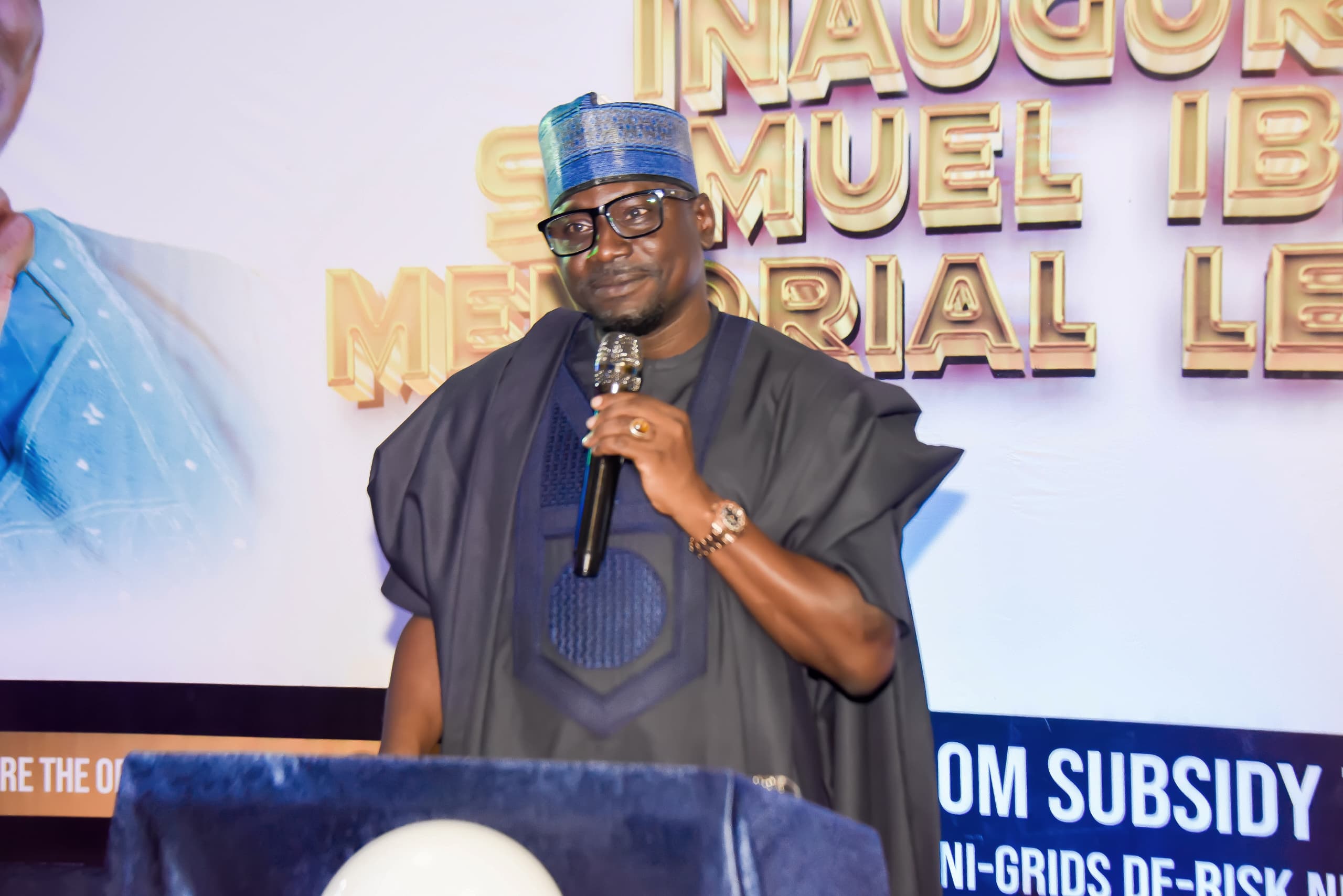
For decades, the story of Nigerian electricity has followed a familiar script: not enough megawatts, not enough transmission lines, not enough generators humming to life. But at this year’s Samuel Ibiyemi Memorial Lecture, honoring the late energy journalist who spent a career chronicling the sector’s struggles, Dr. Abba Aliyu, Managing Director/CEO of Nigeria’s Rural Electrification Agency, argued that the country has been asking the wrong question. It isn’t primarily an engineering problem. It’s a trust problem.
“The challenge therefore is not simply producing more electricity,” Aliyu told the gathering. “It is producing a market that investors trust.”
That reframing carries real weight. Nigerian businesses currently spend an estimated $14 billion a year generating their own power, running diesel generators because the grid can’t be relied upon, even as public money continues to flow into a sector, which is still plagued by liquidity crises among generation companies and chronic losses at distribution companies. The government isn’t short on spending. It’s short on returns.
Aliyu’s central argument is that subsidies aren’t inherently the problem, every advanced economy has used them. The U.S. poured $52.7 billion into semiconductor manufacturing through the CHIPS Act and drew hundreds of billions in private investment behind it. Operation Warp Speed spent roughly $10 billion and compressed a decade-long vaccine timeline into under a year. South Korea subsidized its way into shipbuilding dominance; the Netherlands did the same for agriculture. The distinction, he said, is whether subsidies fund create “recurring consumption or productive assets”, whether they’re a permanent crutch or a temporary bridge to a self-sustaining market.
That philosophy is now showing up in Nigeria’s mini-grid strategy, which Aliyu argues has quietly outgrown its original label as a rural electrification tool. Mini-grids, he said, are increasingly a commercial model in their own right, built on verified demand, digital revenue collection, and lower losses, all of which make cash flows more predictable and, crucially, more fundable.
The scale REA is pointing to is significant. Under the $750 million DARES program, described as Africa’s largest publicly funded renewable energy access initiative, REA is partnering with distribution companies to build 48 interconnected mini-grids, adding roughly 288 MW of clean generation and storage directly into the existing grid. REA says its broader mini-grid push has already produced nearly 200 isolated mini-grids, more than 164,000 mini-grid connections, and around 1.4 million households and businesses reached through stand-alone solar, alongside more than $1.2 billion in private financing commitments. DARES itself is projected to unlock over $1.2 billion in additional private capital and reach 17.5 million Nigerians, a bet that public money spent de-risking projects, rather than propping up inefficiency, can pull far larger sums of private investment behind it.
Whether this works depends on execution that’s historically been the sector’s weak point, regulatory follow-through, distribution company solvency, and whether “verified demand” mini-grid models can scale beyond pilot sites into the messier realities of rural Nigeria. Aliyu framed the ambition plainly: government support that “ultimately requires less government support”, utilities evolving into modern energy platforms, and electricity treated as industrial infrastructure rather than a perpetual welfare line item. It’s an appealing vision, and one that international precedent lends some credibility to. But subsidy reform is easy to announce and difficult to sustain, especially in a sector where past promises have often outpaced delivery. The next few years of DARES rollout, not the speeches, will determine whether “from subsidy to solvency” becomes Nigeria’s actual electricity story, or just its latest slogan.