

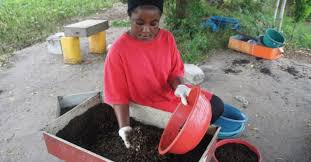
A CABI-led review involving an international team of scientists has revealed that women dominate the value chain of insects used as food and feed in Africa but that their role varies with insects and regions.
In Africa, insects – such as locusts, crickets, grasshopper, the mopane worm, and flies, have long been used as human food and animal feed. This practice is presently being promoted to reduce malnutrition and provide new opportunities for the economic development of the rural poor, in particular women.
Over 470 insect species are eaten across the continent – providing a cheap source of protein and other nutrients to help combat malnutrition. They are also given to livestock as protein feed, helping smallholder farmers diversify their agricultural production alongside the growing of a range of staple crops.
Essential to understand the role of women in all present aspects of the sector
However, gender issues need to be considered at an early stage and, to set up a baseline for such considerations, it is essential to understand the role of women in all present aspects of the sector.
The paper, published in the Journal of Insects for Food and Feed reviews the role of women in the collection, production, processing, marketing and consumption of insects used as food and feed in Africa.
The researchers found that most insects used as human food are still field collected, usually by women, who also lead marketing activities, especially when the market is of low value. Women also prepare and cook the insects.
May be influenced by traditions and taboos
Dr Marc Kenis, an author of the review paper and Head of Risk Analysis and Invasion Ecology at CABI, said, “Consumption is usually shared among men, women and children, but gender balance may vary with insects and regions and may be influenced by traditions and taboos.
“There is less information available on gender roles in the sector of insects as feed, largely because, until recently, only a few insect species were used to feed livestock, and these insects were not traditionally traded.
“Nowadays, systems for producing, processing and marketing fly larvae as feed are being developed but gender issues have not yet been really taken into consideration.”
Female-headed households are resource constrained
The review states that, for example, a household survey in the Limpopo province of South Africa showed that female-headed households are more likely to participate in mopane worm markets and supply more marketable surplus compared to male-headed households, probably because female-headed households are resource constrained, lacking access to productive assets (land, labour, capital) which limits their agricultural production capabilities.
Dr Kenis added that efforts should be made possible to ensure that this emergent activity will also provide business opportunities for women entrepreneurs. But the researchers note a range of challenges facing women including domestic and social obligations which restricts their ability to engage in long-distance trade.
In the miombo woodlands in Zambia, Mozambique, Zimbabwe and Malawi, various edible caterpillars are also widely consumed in rural and urban areas, but little has been published on gender roles in the value chain. Chidumayo and Mbata (2002) observed, in Northern Zambia, that they are harvested by men, women and children, although men harvested at different sites from those used by women and children.
Dr Kenis said, “Although women often play a key role in the harvesting and trade of caterpillars, the situation may strongly vary with region, country and caterpillar species. Direct harvesting of caterpillars in forests is overwhelmingly done by women and children (e.g. more than 80% in Cameroon).
“However, men have a key role when the harvesting technique involves the cutting of host trees, which is commonly practised in some regions, in particular in Democratic Republic of Congo.”
Caterpillars represent most significant income source of many rural women
The researchers add that in rural southwestern Burkina Faso, shea caterpillars are collected by the whole family but are mainly traded by women and, together with shea nuts, caterpillars represent the most significant income source of many rural women, providing economic empowerment and independence.
With regards to insects for animal feed, it is hoped that this practice will promote sustainable industrialisation, increase employment and local technology development in low-income communities, and it is also expected to improve gender equality.
Recent surveys among smallholder farmers in Kenya showed that female farmers appear to be more informed of the opportunities than male farmers (Chia et al., 2020).
In another survey in Kenya (Waithanji et al., 2020), male and female poultry and fish farmers seemed equally informed. However, there is limited published information on the actual role of women in the sector of insects as animal feed in Africa, for various reasons.
In Africa, private enterprises and public programmes are being developed at various scales to provide fly larvae meal to be used directly on the farm and for the feed market.
Black Soldier Fly farming will provide more business opportunities for women
Recent socio-economic studies on the use of Black Soldier Flies (BSF) in Africa have started to provide data disaggregated by gender. For example, Tanga et al. (2021) estimated that, across the BSF farming enterprises emerging in East Africa, out of the total numbers of people recruited to work in insect farms, over 70% of them are women, who have secured dignified and fulfilling employment in the sector.
Dr Kenis said, “This review demonstrates that a significant amount of information is available on the gender division of labour involved in the use of edible insects in Africa, although the availability of quantitative data from large sample sizes is limited.
“Men are increasingly involved in other non-agricultural economic activities and thus predisposing more women to agriculture and to new agricultural technologies such as insect farming.
“Efforts should be made to ensure that the emergent activity of BSF farming will provide more business opportunities for women entrepreneurs at all levels of the value chain as the industry scales up. Culled From Africa.com