


Source: DW
The newly signed African free trade agreement is hailed as a huge step forward by some, but criticized as a mammoth project with little chance of ever coming true by others.
“A good thing, but …” That was the gist of reactions all around the world and in Africa itself concerning the continent’s new intra-continental free trade agreement on the weekend.
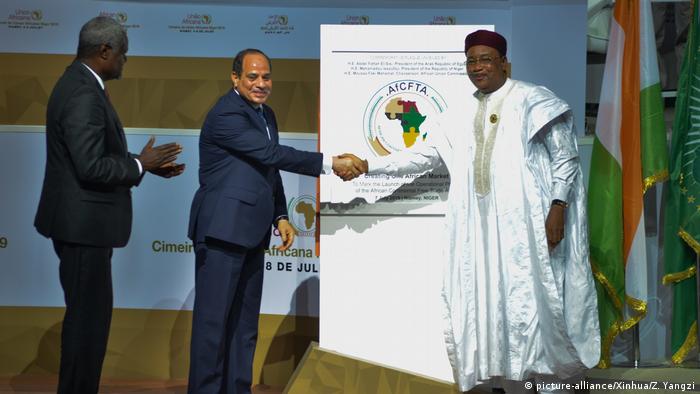
It took 17 years of difficult negotiations, but at Sunday’s summit in Niger’s capital Niamey, the African Union (AU) finally launched the “operational phase” of the African Continental Free Trade Area (AfCFTA). Nations agreed to common “rules of origin, the monitoring and elimination of non-tariff barriers, a unified digital payments system and an African trade observatory dashboard,” according to the AU Commission.
Scared of tariff cuts
Talking to DW, Togo’s Foreign Minister Robert Dussey hailed the agreement, but did not hide the challenges posed by implementation. The AfCFTA commits the majority of countries to 90 percent tariff cuts within a five-year period, thereby reducing barriers to trade on the continent. The deadline had to be prolonged to ten years for those listed as “Least Developed Countries” by the United Nations. Another half a dozen very recalcitrant countries, including Mozambique, Niger and Malawi, obtained an extension of 15 years. “It will need an effort to give them the technical tools to meet the challenges ahead,” Foreign Minister Dussey said.
A former political affairs commissioner of the AU, Aisha Laraba Abdullahi, told DW that fears that eliminating tariffs could harm some African economies are understandable. “We must not provide an opportunity for other countries to come and dump their products on the continent and reduce our manufacturing capacity. We have to be on guard,” especially since only a very small number of African countries “have excelled in manufacturing,” Abdullahi added.
Huge obstacles to free trade
But as users on DW Africa’s Facebook page pointed out, the problem is not just competition from the outside world. Nigerian Umeh Chidozie wrote: “We don’t have electric power; our manufacturers are still struggling to break even. Companies will go to a more stable environment where cost of production will be cheap to manufacture and bring it in to Nigeria’s large market to sell without paying duty. We will lose a lot of jobs.”
There are more obstacles in the way of AfCFTA than just cutting tariffs, experts say. Lack of infrastructure, a fundamental condition for the functioning of trade, is a major problem. Aisha Abdullahi stresses that enhancing the continent’s infrastructure is also on the AU’s agenda: “Ensuring open skies, accelerating our railways, our roads: there are projects already happening on the continent.” Abdullahi acknowledges that there are further difficulties, like corruption, but sees the agenda “on course.”
Keeping Africa from industrializing
Some in the international community are not as optimistic concerning the African free trade zone and have not been hiding their skepticism. Togo’s Foreign Minister Dussey answers them saying that “African development is foremost of the responsibility of Africans.” He accuses some rich countries of not being too keen on seeing Africa industrialize: “You know we have a problem with work for our youth. It is important that we have strong industries to have work for the young,” was his veiled warning to an industrialized world scared about mass migration.
AfCTA has met with mixed reactions by Africans themselves. On DW Africa’s Facebook page, opinions are manifold, with a slight tendency to optimism. But even this optimism is tinged with skepticism, when, for example, Kyebakola Caesar writes: “In form and substance, this all looks a great deal. If only we […] put rhetoric aside and get into real business, then the world will feel us and the African pride will return to us all! African solutions to Africa’s problems! “
Luma Fred worries about implementing a free trade zone in a continent rife with regional instability. “How do you trade in wars and conflicts?” he asks.
1 Comment
Countries with weak economies would experience unfavorable balance of trade