

Uche Cecil Izuora
Energy experts have identified marine wind as veritable energy sources that could play a vital role in reducing fossil fuel reliance and tackling climate change, while also bolstering energy security.
Winds sweep across the world’s oceans every day, and harnessing that largely unused resource has the potential to provide abundant, clean and reliable energy. Experts widely agree that marine wind could play a vital role in reducing fossil fuel reliance and tackling climate change, while also bolstering energy security.
“The beauty of it is that the technology is tried, tested, proven, and has scaled,” says Amisha Patel, head of secretariat at the Global Offshore Wind Alliance. “This is not just about climate, it’s about having energy independence for many nations and regions as well.”
Tapping into only a tiny fraction of that overall potential could reap gigantic benefits. A 2025 paper found that utilizing even just 1 per cent of the global area suitable for offshore wind could produce roughly 20 per cent of current global electricity demand, and cut carbon emissions by more than 2.3 billion metric tons annually.
“Our key finding is that a relatively small fraction of suitable ocean area could deliver substantial climate and energy benefits,” Yi Wen, a lead author on that study with the National University of Singapore (NUS), told Mongabay in an email.
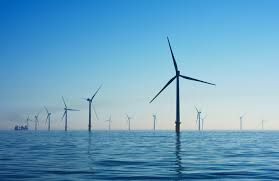
But today, marine wind remains almost entirely untapped, with only a round 15,000 offshore turbines producing just over 80 gigawatts of electricity, and another 150 GW of offshore wind farms under development. In 2024, energy generation from these turbines was sufficient to power around 73 million households.
To date, the lion’s share of offshore wind development has occurred in just a few locations, namely China and Europe. The U.S. remains far off pace due to legal wrangling that has slowed projects; it recently confronted new roadblocks thrown up by the fossil fuel industry-friendly Trump administration. Across Latin America and Asia, offshore wind developments are being planned including in Brazil, Colombia, Japan, South Korea, the Philippines, Vietnam and Taiwan.
“Our resource mapping highlights several high-wind regions that remain comparatively underdeveloped particularly in the Southern Hemisphere such as waters near southern South America, southeastern Australia, and southern New Zealand, as well as Alaska and southeastern Canada,” Wen writes.
Situating wind developments offshore has multiple advantages over siting them on land, experts agree. Marine wind can harness the strong, steady breezes blowing over the seas (terrestrial winds are more intermittent), and avoid competition for scarce and expensive property while feeding energy directly to coastal communities.
In order to meet climate targets set out in the Paris Agreement, roughly 500 GW of offshore wind power is required by 2030, with nearly 2,500 GW needed by 2050, according to the International Renewable Energy Agency (IREA).
The Global Wind Energy Council has set a comparable goal of reaching 2,000 GW of installed capacity by 2050.
“It’s an ambitious target, but it’s reachable,” says Patel from the Global Offshore Wind Alliance. But based on current projections, global capacity will only reach around 238 GW by 2030, less than half of the Paris Agreement target for marine wind, though that would still represent a tripling of current capacity.