

Uche Cecil Izuora
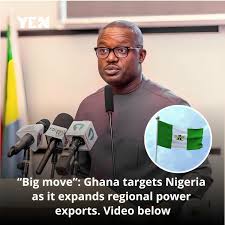
Energy Minister and Green Transition of Ghana, John Abdulai Jinapo, has expressed his country’s willingness to begin supplying electricity to Nigeria as part of a broader regional ambition.
Ghana already exports power to Togo, Benin, Côte d’Ivoire and Burkina Faso, with Nigeria representing a major new target market.
The government’s energy mix plan combines natural gas, renewables and nuclear power to support Mahama’s 24-Hour Economy initiative Ghana’s top stories, now easier to find.
Ghana is moving to add Nigeria to its growing list of electricity export partners, with Jinapor saying the country aims to become a reliable power supplier for the wider West African sub-region. Jinapor highlights a diverse energy mix to support the 24-Hour Economy initiative, according to report published August 21, 2026 by gen.com.gh.
Speaking on the matter, Jinapor said Ghana’s goal is to build enough generation and transmission capacity to meet domestic demand while also serving neighbouring economies. Ghana already has active cross-border electricity arrangements with Togo, Benin, Côte d’Ivoire and Burkina Faso through the Ghana Grid Company (GRIDCo), whose transmission network is physically interconnected with those countries.
Nigeria as Ghana’s next power market Nigeria presents a particularly significant opportunity. With a population of over 200 million people, it is one of Africa’s largest electricity markets.
However, Jinapor acknowledged that reaching Nigeria would require expanding transmission infrastructure to handle the volume of power trade involved. “…power required to support Ghana’s ambition to become the energy hub in West Africa.
And already, Ghana is exporting power to Burkina Faso, Benin, Togo, Côte d’Ivoire, and we are working to export power to Nigeria,”
Ghana’s Minister for Energy and Green Transition, Dr John Abdulai Jinapor, shared these remarks during a public event on August 21, 2026.
“So clearly, this falls in line with our vision, and we believe that if we can achieve this, Ghana can become an energy hub for the whole of the West African region in the shortest possible time,” he added.
Nuclear power and the 24-Hour economy Beyond regional exports, the minister also outlined Ghana’s long-term energy mix strategy.
That reliability, Jinapor argued, is critical to President John Dramani Mahama’s 24-Hour Economy initiative, a policy designed to encourage businesses and industries to extend their operating hours beyond the conventional working day.
The minister said nuclear power in particular, alongside gas and renewables, would provide the consistent electricity supply needed to sustain industrial activity at that scale.