

Uche Cecil Izuora
Iran has sent a stern warning asking the world to brace for oil prices soaring to $200 per barrel as its forces struck merchant vessels on Wednesday, deepening fears of a global energy crisis and intensifying one of the worst oil shocks since the 1970s.
Also, traffic through the strait of Hormuz remains minimal, with just two crude and product tankers sailing through today and only one making the transit the day before, compared with a historical average of 138 ships per day.
Daily transits through the strait of Hormuz, in either direction, have not exceeded five ships since the start of the US-Iran war, according to JMIC in a notice shared by UK Maritime Trade Operations (UKMTO).
The transits include Iranian tankers, with one VLCC that probably recently sailed through.
Most of these tankers have been tracking using their Automatic Identification System (AIS) system, although it was disabled for part of the transit. Several more tankers have probably made the transit with their AIS totally dark, but overall journeys through the region remain minimal.
The lack of transits through Hormuz has led at least one charterer, Admic, to charter ships for a floating storage contract, and others may follow as portside storage fills up.
Seven dry bulk carriers sailed through on 10 March — the highest since the war began — with no other day this month exceeding four. More dry bulk carriers than crude or product tankers have transited the strait.
Traffic may be further hampered by the possibility of Iran attempting to mine the strait.
This would have a significant impact on shipowners’ willingness to attempt the journey.
Three vessels were attacked in the region as Iranian activity appeared to mount.
UKMTO said it has received 17 incident reports involving vessels in the Mideast Gulf, the strait of Hormuz and the Gulf of Oman since the conflict started. These included 13 attack reports and four reports of suspicious activity.
Spokesperson for Iran’s military command, Ebrahim Zolfaqari, said, “Get ready for oil at $200 a barrel because the oil price depends on regional security, which you have destabilised,” in an address to Washington, signaling they intend to inflict a prolonged economic shock.
Zolfaqari also warned that Iran could begin targeting banks doing business with the United States or Israel, advising civilians across the Middle East to stay at least one kilometre away from bank buildings.
The warning came as the International Energy Agency (IEA) urged countries to release massive volumes from their strategic oil reserves to stabilise markets rattled by the rapidly escalating conflict.
Oil prices surged more than four per cent on Wednesday, after briefly climbing to nearly $120 a barrel earlier in the week. It settled around $90 yesterday after Trump’s assurance that the war would soon end, reflecting mounting fears of supply disruptions.
Stock markets, including Wall Street’s major indexes, fell as investors reassessed earlier hopes that Washington might push for a quick end to the conflict.
To contain the crisis, the International Energy Agency recommended releasing 400 million barrels from global strategic reserves, the largest coordinated intervention in history. Washington quickly backed the proposal.
But analysts note that even such a massive release would replace only a fraction of the oil normally transported through the Strait of Hormuz.
Nearly two weeks after joint US and Israeli airstrikes triggered the war, the violence has already claimed about 2,000 lives, most of them Iranians and Lebanese, while the fighting spreads across the Middle East, throwing energy markets and shipping routes into turmoil.
Despite what the Pentagon described as the most intense bombing campaign since the war began, Iran continued to retaliate on Wednesday, firing missiles at Israel and targets across the region, demonstrating its capacity to sustain the fight.
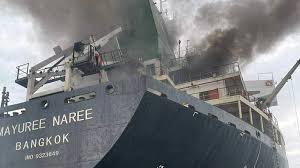
In the Gulf, three commercial vessels were reported hit after Iran’s Revolutionary Guards said they had opened fire on ships that ignored their warnings.
A Thai-flagged bulk carrier caught fire, and its crew had to abandon ship, with three sailors reported missing.
Two other ships, a Japanese-flagged container vessel and a Marshall Islands-flagged bulk carrier were also damaged by projectiles. The incidents bring the total number of merchant ships struck since the conflict began to 14.
Shipping through the Strait of Hormuz, the narrow passage that carries around one-fifth of the world’s oil, remains effectively paralysed.
Although Trump said vessels ‘should continue transiting the Strait, sources reported that Iran had deployed around a dozen naval mines, making the route increasingly dangerous.
The US military has warned civilians to stay away from Iranian naval ports. Tehran responded with a stark threat insisting that if those ports are attacked, economic and commercial centers across the region would become “legitimate targets.”
Meanwhile, missile and drone strikes continued across the Middle East as Iran said it had fired missiles at a US base in northern Iraq, the US Navy’s regional headquarters in Bahrain, and targets in central Israel. Explosions were heard in Bahrain, while two drones crashing near the airport in Dubai left four people injured.