

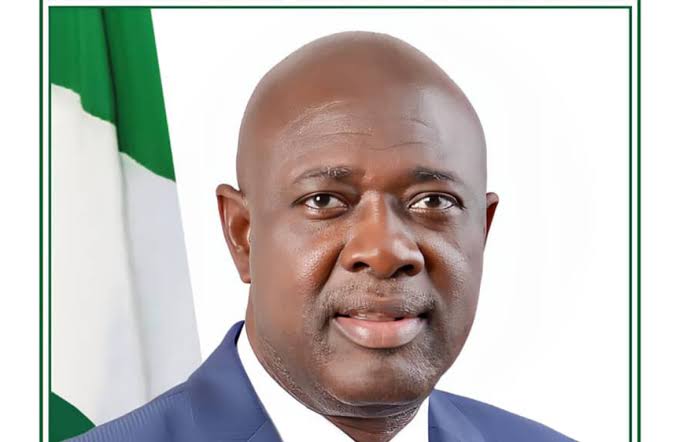
Uche Cecil Izuora
The Minister of State for Petroleum Resources (Oil), Sen. Heineken Lokpobiri, and Ekperikpe Ekpo, Minister of State for Petroleum Resources (Gas), have been confirmed as speakers at the African Energy Week (AEW) 2026 in Cape Town from October 12–16.
Their participation highlights Nigeria’s positioning not only as one of Africa’s leading hydrocarbon producers, but also as a central driver of cross-border investment and institutional frameworks shaping the continent’s energy future.
That momentum is underpinned by a strengthening upstream sector. Nigeria’s crude oil and condensate production reached approximately 1.7 million barrels per day in May 2026, a 15-month high and the first time the country has exceeded its 1.5 million barrels per day OPEC quota this year.
Output has steadily risen from 1.48 million barrels per day in February, supported by improved pipeline security and reduced crude losses.
The government is now targeting 1.8 million barrels per day by year-end, alongside an ambitious $10 billion upstream investment drive through its 2025/2026 licensing round, which spans 50 oil and gas blocks across onshore, shallow-water, deepwater and frontier basins.
This production recovery is unfolding alongside a structural shift in Nigeria’s upstream landscape.
A wave of IOC divestments from onshore and shallow-water assets has accelerated the rise of indigenous operators. Shell, TotalEnergies, Eni, ExxonMobil and Equinor have collectively divested more than $6 billion in assets to local firms including Renaissance Africa Energy, Oando, Seplat Energy and Chappal Energies. As a result, indigenous producers now account for roughly 60% of Nigeria’s crude output.
At the same time, IOCs are increasingly concentrating capital in deepwater developments, signaling a rebalancing rather than an exit from the market. Shell and its partners are assessing a potential $20 billion investment in the Bonga South West field, while Eni continues to expand its deepwater footprint through the conversion of OPL 245 into new development and exploration licenses. Chevron has also announced plans for a new rig near the Agbami field in late 2026.
Together, these dynamics are reshaping Nigeria into a more diversified upstream market – one where indigenous producers are expanding operational control while international players concentrate on capital-intensive offshore developments. This evolving structure is also creating new opportunities for regional collaboration, particularly with South Africa, which is emerging as a key downstream partner and investment counterpart.
With AEW 2026 hosted in Cape Town, the Nigeria–South Africa energy relationship is expected to feature prominently. Bilateral trade between Africa’s two largest economies reached $2.16 billion in 2025, driven largely by South Africa’s reliance on Nigerian crude imports.
South Africa is increasingly positioning Nigeria as a strategic supply source amid shifting global energy flows. More than 60 South African companies have invested an estimated $7.8 billion in Nigeria since 2003, reflecting deepening commercial ties across hydrocarbons, infrastructure, and energy services.
These bilateral flows are increasingly being supported by a broader continental financing architecture.
Central to this is the planned Africa Energy Bank, headquartered in Abuja, which is expected to begin operations in September 2026. Established by the African Petroleum Producers’ Organization and Afreximbank, the institution will launch with an initial capital base of $5 billion and aims to mobilize $10 billion in its first phase, with early focus on Nigeria, Angola and Libya.
The bank is designed to address the financing gap created by the retreat of Western lenders from African hydrocarbons, offering risk-sharing mechanisms and project validation tools intended to crowd in international capital. Its launch ahead of AEW 2026 positions it as a key reference point in discussions around how Africa finances its next wave of upstream growth – particularly in markets like Nigeria, where project pipelines are expanding but capital access remains uneven.
“Nigeria’s presence at AEW with both ministers reinforces that the country is not only open for upstream investment but is also helping build the pan-African institutions and bilateral partnerships required to finance and deliver it.
The Africa Energy Bank, the licensing rounds and the strengthening Nigeria–South Africa corridor all point in the same direction,” said NJ Ayuk, Executive Chairman of the African Energy Chamber.
AEW 2026 will convene heads of state, ministers, operators, and investors at the Cape Town International Convention Center from October 12–16, as the continent seeks to translate rising production, evolving IOC strategies and emerging financing structures into sustained upstream growth.