

…As Rivers Politics Takes New Dimension
Moses Ofodeme
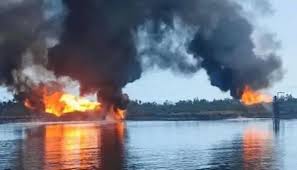
Nigeria’s Trans Niger Pipeline, a major oil artery transporting crude from onshore oilfields to the Bonny export terminal, was shut after a blast that caused a fire, police said on Tuesday.
Nigerian oil consortium Renaissance Group, which now owns Shell’s former onshore subsidiary that operates the pipeline, earlier confirmed the blast in coastal Rivers State and dispatched a team to investigate.
The Trans Niger Pipeline (TNP), with a capacity of around 450,000 barrels per day, is one of two conduits that export Bonny Light crude from Nigeria, Africa’s biggest oil producer.
Rivers State Police said in a statement the situation was now under control and they had started investigations to determine the cause of the blast on Monday night.
“In connection with this, two individuals have been taken in for questioning as part of efforts to uncover any potential act of sabotage,” the police said.
It was not immediately clear how long the TNP would be shut. A prolonged outage could, however, force its operators to declare force majeure on Bonny Light exports.
Pipeline sabotage and crude theft are some of the major reasons that forced oil majors like Shell, Exxon Mobil, Total and Eni to sell their onshore and shallow-water fields in Nigeria to concentrate on deep-water operations.
Renaissance Group, which includes Nigerian exploration and production companies Aradel Energy, First E & P, Waltersmith, and ND Western, along with the international energy group Petroline, completed the acquisition of Shell’s former onshore assets last week.
Meanwhile, the Federal Government has declared a state of emergency in Rivers State, after an apparent attack on the Trans-Niger Pipeline (TNP) halted crude movements to Nigeria’s Bonny Light export terminal.
A fire occurred on the pipeline at the border of the Kpor and Bodo communities, and the pipeline’s management has shut down the affected section, the Rivers State police said. Operator Renaissance Africa said it is responding to an incident.
The 180,000 b/d, 60km TNP carries crude to the Bonny terminal, from where the Bonny Light grade is exported. TNP was operated until 14 March by Shell subsidiary SPDC.
The pipeline has been the target of repeated oil theft, vandalism and sabotage in the past, and Shell shut the TNP entirely between April and October 2022. President Bola Tinubu, said the resumption of “disturbing incidents” had happened “without the State Governor taking any action to curtail them”. Tinubu suspended the Rivers State Governor and his deputy and said the region will be under federal control, effective immediately.
It is unclear what if any effect this will have on the region’s oil production, a source within state-owned oil firm NNPC told Argus.
But it appears the pipeline attack has halted loadings at the Bonny terminal. The Almi Voyager was the most recent tanker to load there, with around 550,000 bl of crude on 14 March. Loading operations are seemingly halted as the pumping of 475,000 bl to NNPC’s 210,000 b/d Port Harcourt refinery was the next scheduled operation before the explosion.
Market sources said they are monitoring the situation and awaiting a possible declaration of force majeure by Renaissance Africa. Sources added that loading operations at the export terminal were already running up to two weeks behind schedule.
The Trans-Niger Pipeline, one of Nigeria’s biggest pipelines carrying crude from the Niger Delta to the Bonny terminal, was rocked by a powerful explosion on Monday night, just as OPEC’s top African producer had started to raise oil production and exports.
The explosion at Bodo, Gokana Local Government Area of Rivers State, caused a massive fire at the section of the pipeline in the area, Nigerian media report.
As of early Tuesday local time, the authorities haven’t announced what caused the explosion—vandalism, theft, or some incident.
While the cause of the explosion has yet to be investigated and announced, there is already speculation that the blast could be the result of sabotage, in view of the threats that militant groups in the area have recently made.
The militants have threatened to attack oil infrastructure in the Rivers state amid an ongoing political crisis between the state and the federal government over federal money allocation to Rivers.
The pipeline is operated by Shell Petroleum Development Company of Nigeria Limited (SPDC) and transports crude oil from the oilfields in the Rivers and Bayelsa states to the Bonny export terminal which loads the Bonny Light grade, one of Nigeria’s premium crudes.
The new setback in Nigeria’s oil industry comes just as the country has increased its crude oil production in recent months. In February, Nigeria is estimated to have exceeded its OPEC + quota thanks to higher exports and increased demand from the newest African refinery, Dangote.
Nigeria began to raise its oil production last year, after years during which it consistently failed to pump to its OPEC+ quota due to oil theft and vandalism and struggles to launch new projects.
Oil theft and pipeline vandalism have long plagued Nigeria’s upstream oil and gas industry, driving majors out of the biggest OPEC producer in Africa and often resulting in force majeure at the key crude oil export terminals.