

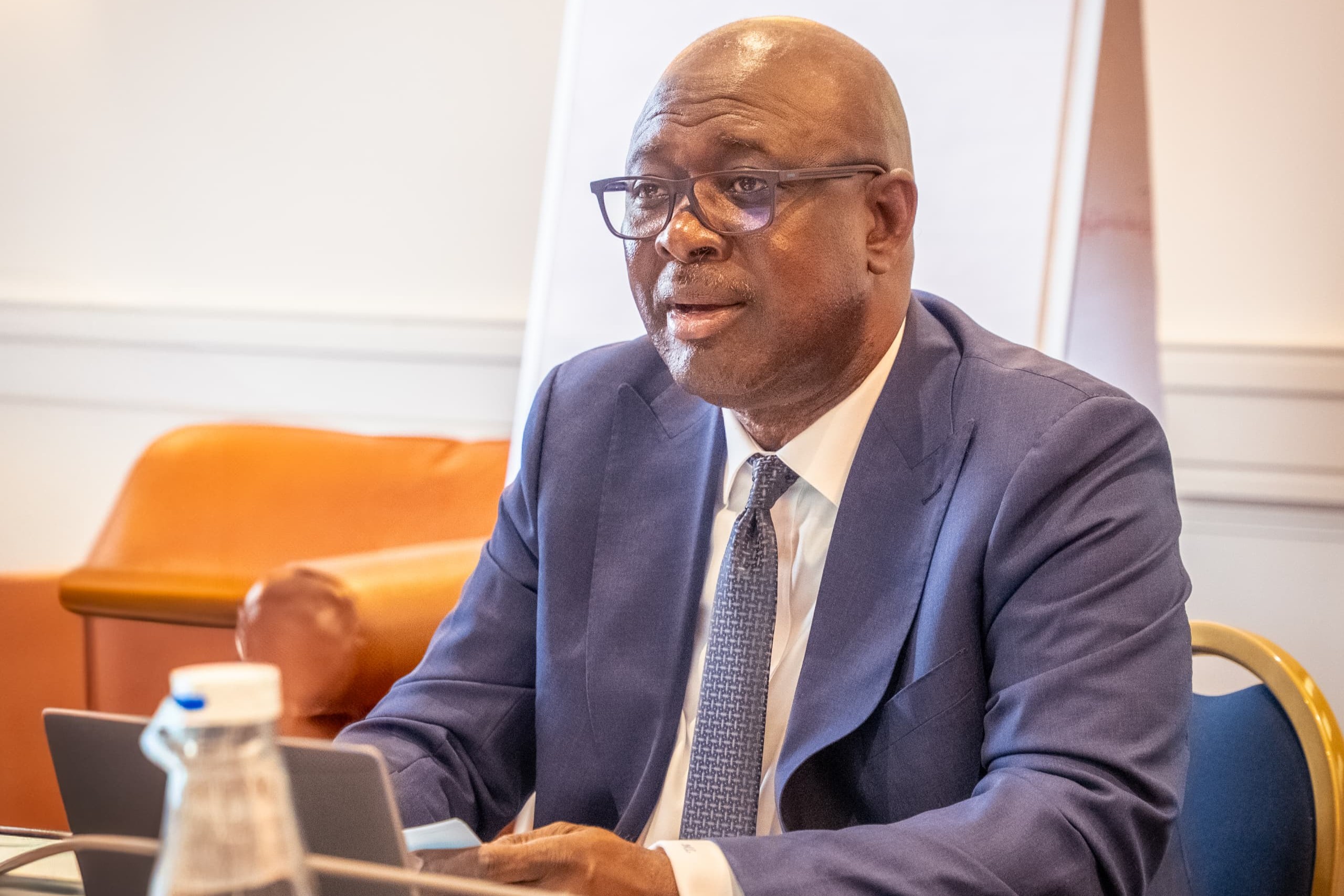
Joseph Bakare
After announcing a leap in oil production output which is currently put at about 1.745 million barrels of crude oil per day (bpd) and aiming to hit two million bpd by the end of 2025, the Minister of State for Petroleum Resources (Oil), Heineken Lokpobiri, says Government has issued a bold ultimatum to oil and gas operators in Nigeria: deliver measurable results or relinquish control of national assets.
Lokpobiri, informed about this bold decision at the 2025 edition of the Nigerian Oil and Gas (NOG) Week in Abuja.
Nigeria has consistently struggled to meet its Organisation of Petroleum Exporting Countries crude production quota, falling short by hundreds of thousands of barrels daily due to a combination of oil theft, underinvestment, and operational inefficiencies.
In May 2025, the Nigerian Upstream Petroleum Regulatory Authority disclosed that Oil production in Nigeria decreased to 1,452,941 barrels of oil per day, representing a 2.20 percent drop compared to the 1,485,700 bpd in April.
The development underscores the broader challenges facing Nigeria’s oil and gas sector, where underinvestment, regulatory bottlenecks, and dormant licenses have continued to hamper growth despite improved midstream infrastructure.
Speaking under the event’s theme, “Accelerating Energy Progress Through Investment, Global Partnerships and Innovation,” Lokpobiri called for urgent and coordinated action to reverse the downward trend in national oil production, stressing that the era of excuses and underperformance is over.
“It is no longer acceptable for critical national resources to remain in the hands of companies that lack the technical or financial capacity to optimize them.
“The era of dormant fields and underperforming assets must give way to action”, Lokpobiri warned.
The Minister revealed that President Bola Tinubu has directed the Board of the Nigerian National Petroleum Company Limited (NNPC Ltd) to review all existing operatorship arrangements to ensure they align with national development goals.
He said partnerships and agreements, including Joint Ventures and Financial/Technical Services Agreements (FTSAs), must not become tools to hold the sector hostage.
“If you cannot act in the nation’s best interest, then it’s time to step aside or step up through meaningful partnerships,” he declared, urging companies to re-enter shut-in wells and turn dormant licenses into productive assets.
Lokpobiri expressed deep concern that despite the passage of the Petroleum Industry Act (PIA) and the implementation of numerous investment incentives and executive orders, production has not improved.
“Last year, we stood here and spoke passionately about increasing production. Yet today, we find ourselves asking: what has truly changed?” he asked
The Federal Government thus declared an end to what it described as the “era of speculative licensing,” where companies acquire oil blocks but fail to develop them, hence putting an end to dormant oil fields.
Speaking further at the conference, Lokpobiri, warned that the government would no longer tolerate operators lacking the technical and financial capacity to develop oil fields, stressing that such licenses would be withdrawn.
He also revealed that the government has engaged a consultant who is a member of the Oil Producing Trade Section to work in partnership with the NUPRC to harmonise the 273 fees in the oil and gas industry.
The consultant has been mandated to study the fees of other oil-producing countries and fashion the Nigerian fees after them in line with international best practices. Lokpobiri said that without the harmonisation of the fees, investors would avoid Nigeria for other climes.
He said, “And we agreed that there should be an international consultant to benchmark our fees away with other countries in the world so that we can be competitive. Otherwise, nobody would come and invest in a place where there would be 272 fees arranged and more were coming.”
He explained that the government was determined to maximise oil production by ensuring that only serious investors retain access to Nigeria’s hydrocarbon resources.
Lokpobiri said, “It is no longer acceptable for critical national resources to remain in the hands of companies that lack the technical or financial capacity to optimise them or worse, those who use such licenses merely as a lever to access scarce capital, only to divert it to unrelated ventures.
“Our oil and gas industry has witnessed far too many cautionary tales of this nature, and we must now draw a clear line. Let’s be clear: Joint Ventures and Financial/Technical Services Agreements are not weapons to hold the sector hostage. They are frameworks built on trust that you will act in the nation’s best interest. If you cannot, it’s time to step aside or step up through partnership.
“In this regard, the Federal Government is prepared to re-evaluate existing partnerships in the oil and gas sector to ensure that they align with our strategic national objectives for resource development and economic value creation.”
The Minister of State Petroleum Resources (Gas), Ekperikpe Ekpo, said Nigeria had proven gas reserves of over 200 trillion cubic feet, yet value would only be created when resources were developed and utilised
Ekpo said that through the Decade of Gas initiative, the country was focused on translating its vast gas wealth into tangible socio-economic benefits.
This, he said, included driving industrialisation, expanding power generation, increasing domestic Liquefied Petroleum Gas usage, deepening gas-to-transport adoption, and growing gas export capacity.
The NNPCL, also revealed breakthroughs in tackling pipeline vandalism and ensuring full availability of key crude oil pipelines. It, however, lamented that despite this, Nigeria’s crude production still lags behind government targets.
The Company on Tuesday announced that five of its major crude evacuation pipelines achieved 100 per cent availability between May and June 2025, a milestone in the ongoing efforts to stabilise Nigeria’s oil infrastructure.
The pipelines include the Trans-Niger Pipeline, Oando Brass Pipeline, Trans Forcados Pipeline, Trans Escravos Pipeline, and the Trans Ramos Pipeline, all of which traverse critical economic corridors in the Niger Delta and are essential for moving crude oil from wellheads to terminals for export.
However, despite these gains, the NNPCL Group Chief Executive Officer (GCEO), Bayo Ojulari, lamented that oil producers have failed to ramp up output to meet the national production target of 2.02 million barrels per day as projected in the 2025 budget.
Speaking in his keynote address, at the NOG, the GCEO announced a full recovery in pipeline infrastructure security and capacity across the country.
According to him, as of June 29, 2025, the country had achieved 100 per cent pipeline availability, a feat he described as “previously unthinkable” given the long history of sabotage and vandalism in the sector. However, he noted that while pipeline access is no longer a constraint, the country’s oil production levels remain below potential.
He said, “For years, whenever we gathered at this event, we lamented the insecurity around our pipeline network and its impact on crude oil production. But I am pleased to share with you today that, through the collective efforts of the federal government, regulatory bodies, the military, and the industry, we have 100 per cent pipeline availability today.
“As of last month, we averaged 1.35 million barrels per day in crude production, and with condensates, it came to about 1.6mbpd. So now that the pipelines are available, the question becomes: where is the production?”
Ojulari attributed the suboptimal output to years of underinvestment, warning that Nigeria must urgently attract new capital into the oil and gas sector to take full advantage of the restored infrastructure and favourable market dynamics.
“We have solved the infrastructure bottleneck, now we need investments to raise production. The stars are beginning to align, and this is the time to act,” he said.
The GCEO called on both local and international investors to take advantage of Nigeria’s improved pipeline security, regulatory reforms, and expanding gas infrastructure to commit fresh capital to upstream and midstream projects.
Ojulari also announced a breakthrough in its ongoing $2.8bn Ajaokuta-Kaduna-Kano gas pipeline project, confirming that contractors have successfully crossed the River Niger, a critical milestone that had previously posed significant technical and commercial challenges.