

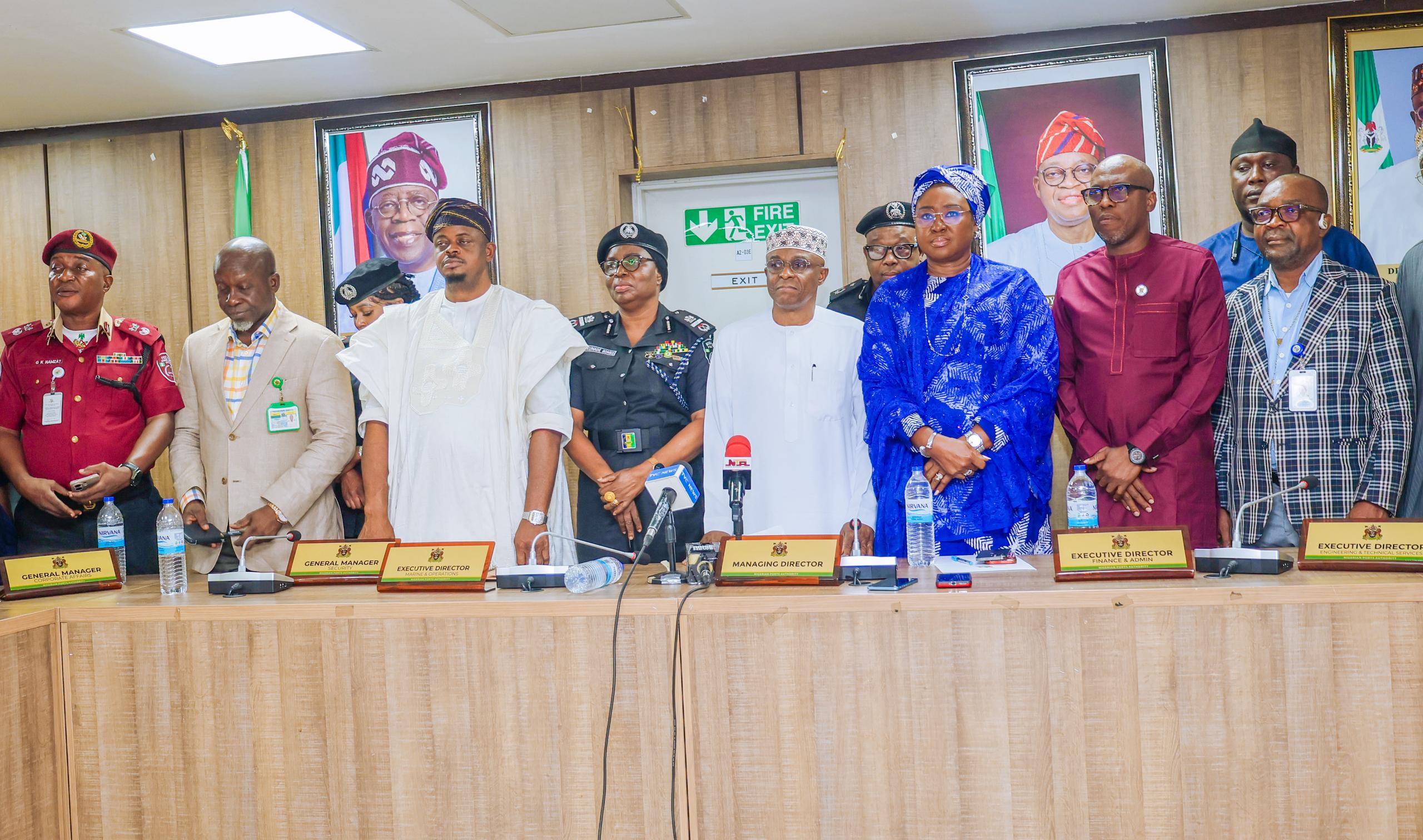
Managing Director/CEO NPA Dr. Abubakar Dantsoho (4th Right) Asst. Inspector General of Police (Maritime) AIG Nurat Okunade (4th Left), Rep. Commissioner of Transport Lagos, Mr. Ojowuro Olasunkanmi (2nd Right) Executive Director F&A NPA Mrs Vivian Richard-Edet (3rd Right), Executive Director M&O Engr. Olalekan Badmus(3rd Left), Secretary-General National Association of Government Approved Freight Forwarders (NAGAFF) Dr. Godfrey Nwosu (1st Right) General Manager Security NPA, Mr. Anthony Edosomwan (2nd Left) and FRSC Sector Commander Lagos, Corp Commander Ganiyu Hamzat (1st Left) on Tuesday 23rd June, 2026 during Port Stakeholders Meeting convened by the NPA to address issues of Jurisdictional Overlaps and extortion along Tincan and Apapa Ports access roads.
Uche Cecil Izuora
The Nigerian Ports Authority (NPA) and the Nigeria Police Force have moved to crack down on unauthorised checkpoints and roadblocks along the Apapa and Tin Can Island port corridors, in a renewed effort to ease congestion and improve efficiency along Nigeria’s busiest logistics routes.
The Managing Director of the NPA, Dr. Abubakar Dantsoho, disclosed this after a high-level stakeholder meeting in Lagos, where security agencies, freight forwarders and transport unions agreed on measures to eliminate operational bottlenecks affecting port access roads.
According to him, investigations revealed multiple challenges along the corridors, including illegal extortion points, jurisdictional overlaps among security agencies, and distortions that have slowed down cargo movement.
“We have problems along the port corridor in Apapa and Tin Can Island. Now, we have established that there are issues around expulsion along the corridor. That is outside the port,” Dantsoho said.
He explained that some of the operational disruptions extend beyond the immediate port environment, noting that activities around Berger and Mile 2 also fall within the affected corridor network.
The NPA boss also identified jurisdictional conflict between security agencies as a major concern.
“The second issue is the issue of overlap, jurisdictional overlap. In our system, what is established is that there is a police command for the port system, Maritime Police, and then there is also the Lagos State Police Command. So, in some instances, there are clashes, overlaps,” he said.
Dantsoho said the meeting reached important resolutions aimed at improving coordination among all stakeholders to ensure smoother port corridor operations.
According to him, both the Maritime Police and the Lagos State Police Command have now denied authorising the establishment of checkpoints along the corridors.
“We have achieved a great lot of success in our discussions… The AIG Maritime Police has clearly stated that they do not send anybody to go and form roadblocks or checkpoints on the corridor. Equally, the Lagos Police Command has said the same thing,” he stated.
He described the development as a positive step toward eliminating delays that have long frustrated importers and exporters.
Dantsoho added that all relevant agencies, including security organisations, freight forwarders, and government bodies, have committed to deeper collaboration to enhance efficiency and position Nigeria’s ports as regional leaders.
“Our emphasis will be that we are going to function, and then function better in our practices, so we can do better than our neighboring countries,” he said.
He further noted that Nigeria’s port system has already received global recognition for improvement.
“Our port system inside the ports have recently been confirmed as one of the most improved in the world by the World Bank,” Dantsoho said, attributing the progress to ongoing reforms under the federal government.
He expressed optimism that the latest agreements would significantly reduce congestion and improve cargo flow along the Apapa and Tin Can corridors.
“I want to thank you for coming to support us. We have achieved a great success from this meeting. The discussions were of high quality, and the outcome, I believe, is also high quality,” he added.
Speaking earlier, the Assistant Inspector-General of Police in charge of Maritime, Okunade Ronke, denied claims that police officers are deployed to checkpoints along the Lagos port corridors, insisting that any personnel found extorting truckers under such pretenses are acting illegally.
She said the discussions were productive and had produced a consensus on a coordinated way forward to address the challenges affecting port access roads.
Okunade explained that agencies agreed to establish a joint task force comprising the Lagos State Government, the NPA, the police, and other relevant stakeholders to ensure smoother operations around the Apapa and Tin Can Island port corridors, with a focus on eliminating extortion and improving traffic flow.
According to her, there are no officially sanctioned police checkpoints along the port access routes, stressing that any officer found operating under claims of deployment from Zone 2 or the Maritime Police is acting fraudulently and should be reported for disciplinary action.
“We have never posted officers to any checkpoint around the port environment,” she said, adding that complaints of illegal activity would be escalated to the appropriate authorities for investigation and sanction.
She noted that the new collaborative framework would help streamline enforcement and reduce jurisdictional conflicts that have previously complicated operations along the corridor.
Stakeholders at the meeting, including representatives of the Nigerian Ports Authority and the Association of Maritime Truck Owners (AMATO), welcomed the move, describing it as a step toward addressing long-standing concerns about extortion, harassment, and disruption of cargo movement.
They also agreed that a broader committee would be constituted, bringing together government agencies, freight forwarders, and transport operators to develop clear terms of reference for sustained monitoring and enforcement.
The Lagos State Commissioner for Transportation also emphasized the need for inter-agency cooperation, noting that the issue goes beyond transportation alone and involves security and regulatory enforcement across multiple jurisdictions.
He added that while illegal operators are occasionally arrested and prosecuted, sustained collaboration among stakeholders remains key to resolving the challenges permanently.
At the end of the meeting, participants expressed optimism that the coordinated approach would improve security, ease congestion, and enhance the overall efficiency of operations along the Lagos port corridors.